 Millets National Media Portal
Millets National Media Portal
Millets National Media Portal
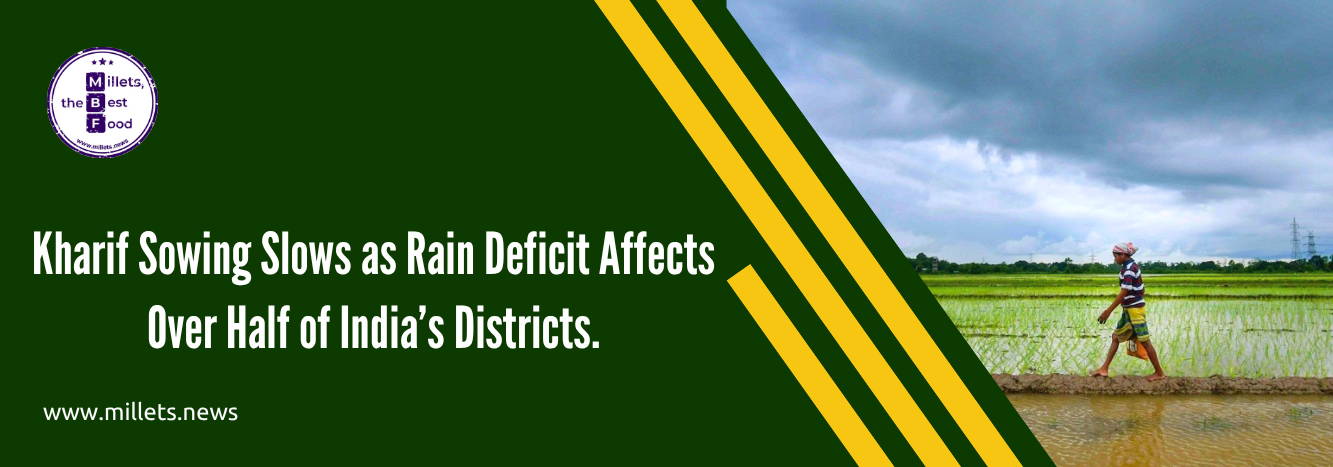
The 2026 kharif sowing season has witnessed a slower start across India as rainfall deficits and the growing threat of El Niño continue to affect agricultural activities. According to the Ministry of Agriculture and Farmers’ Welfare, the total area under key kharif crops such as paddy, pulses, millets, oilseeds, and cotton has declined compared to the same period last year. With over half of India's districts recording below-normal rainfall, farmers are facing delays in field preparation, seed sowing, and crop establishment. The situation highlights the increasing vulnerability of Indian agriculture to changing weather patterns and reinforces the importance of climate-resilient farming practices.
Paddy, India's largest kharif crop, has experienced a noticeable decline in sowing acreage during the current season. As of July 10, paddy cultivation covered approximately 114.69 lakh hectares, significantly lower than the 125.53 lakh hectares reported during the corresponding period last year. Delayed monsoon arrival across major agricultural states, including Gujarat, Madhya Pradesh, Chhattisgarh, and Maharashtra, has slowed planting activities. Farmers dependent on timely rainfall have postponed sowing while waiting for sufficient soil moisture to ensure successful crop establishment and healthy plant growth.
The impact has been even more pronounced for pulses, millets, and oilseeds. Pulses recorded a substantial reduction in cultivation area, particularly for important crops such as arhar, urad, and moong. Oilseed cultivation also witnessed a considerable decline, while cotton acreage dropped as farmers remained cautious due to uncertain rainfall conditions. Among millet crops, bajra cultivation decreased significantly, primarily because it is extensively grown under rainfed conditions. Since millets rely heavily on seasonal rainfall during early growth stages, delayed precipitation has directly affected sowing progress across several states.
Millets continue to play a crucial role in India's dryland agriculture due to their exceptional drought tolerance, lower water requirements, and ability to grow under challenging environmental conditions. Crops such as pearl millet (bajra), finger millet (ragi), foxtail millet, and sorghum have long supported farmers in semi-arid and rainfed regions. However, even these climate-resilient grains require adequate rainfall during sowing to ensure proper germination and early crop development. The current rainfall deficit demonstrates that while millets are more adaptable than many conventional cereals, timely monsoon rains remain essential for achieving optimum productivity.
According to the India Meteorological Department (IMD), nearly 54 percent of India's 741 districts experienced deficient to highly deficient rainfall between June 1 and July 13, while only 46 percent received normal or excess rainfall. This uneven distribution of rainfall has created significant regional disparities in agricultural operations. Areas with delayed or weak monsoon activity are witnessing slower sowing progress, whereas regions receiving normal rainfall have been able to continue cultivation with fewer disruptions. Such variability has become increasingly common as climate change influences monsoon behavior across the country.
The possibility of a weak to moderate El Niño developing during July and August has prompted the Government of India to closely monitor the agricultural situation. Review meetings involving the Prime Minister's Office, the Ministry of Agriculture and Farmers' Welfare, and other concerned agencies are focused on assessing rainfall conditions, crop progress, and contingency planning. Agricultural experts continue to advise farmers to adopt climate-smart practices, use drought-tolerant crop varieties, conserve soil moisture, and follow region-specific advisories to reduce production risks during uncertain weather conditions.
The current kharif season underscores the urgent need to strengthen India's agricultural resilience through improved irrigation infrastructure, better weather forecasting, climate-adaptive crop planning, and wider promotion of resilient crops like millets. As rainfall patterns become increasingly unpredictable, investing in sustainable farming practices, efficient water management, and diversified cropping systems will be essential for ensuring food security, protecting farmer livelihoods, and maintaining stable agricultural production in the years ahead.
© 2023 - 2026 Millets News. All rights reserved.

