 By Admin
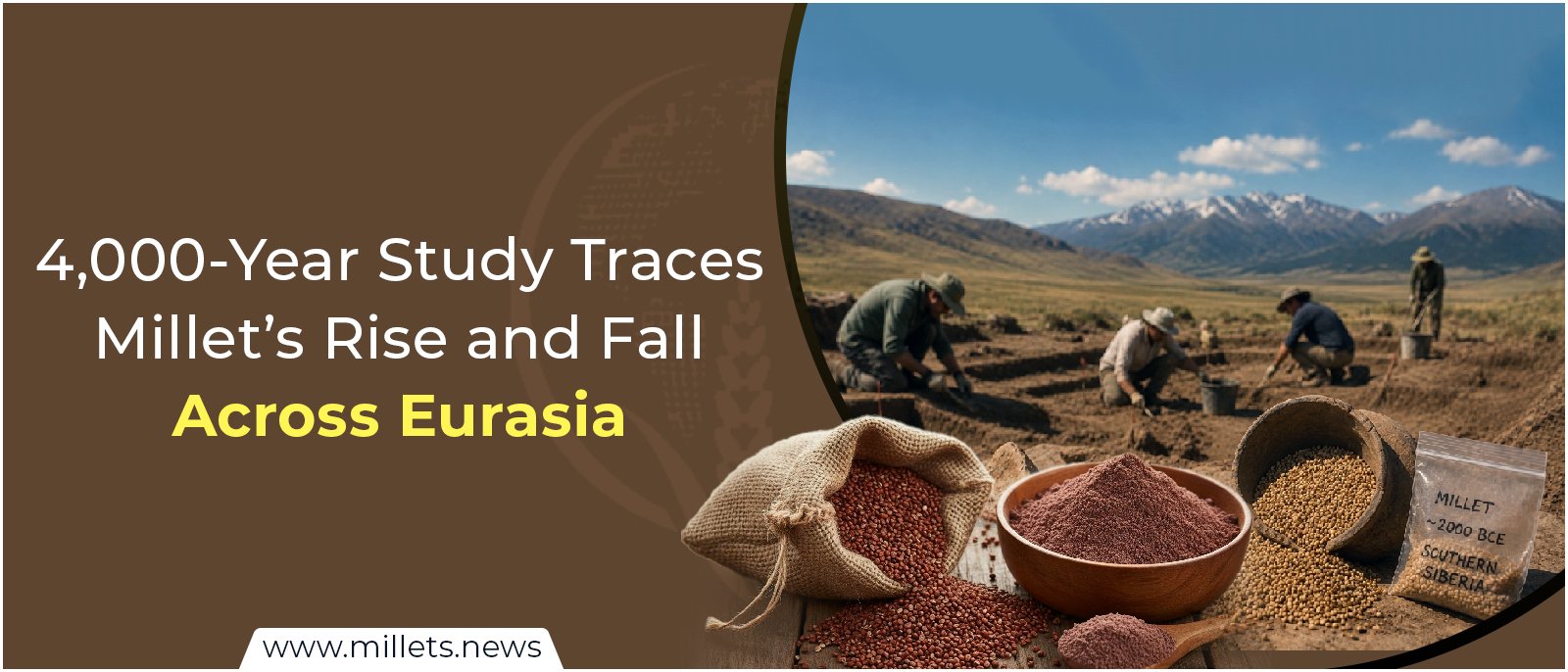
A remarkable 4,000-year reconstruction of human diets has revealed how broomcorn millet rose to prominence and later declined across the central-eastern Eurasian Steppe. By combining new archaeological evidence from Xinjiang with nearly 1,500 previously published isotope records, researchers identified strikingly synchronized dietary changes across populations separated by vast distances and diverse cultural environments.
The research was led by Dr. Wei Wang of Nanjing University of Information Science and Technology and Professor Chengbang An of Fudan University, working with researchers from institutions including the Institute of Cultural Relics and Archaeology in Xinjiang. The team analysed carbon and nitrogen stable isotopes preserved in human and animal bones from the Baiyanghe cemetery near the northern foothills of the Tianshan Mountains.
Combined with radiocarbon dating, the archaeological material enabled researchers to reconstruct dietary changes extending from the Late Bronze Age through the Tang Dynasty. The team then compared the Xinjiang evidence with isotope records from the Minusinsk Basin, Altai Mountains, central Kazakhstan, southeastern Central Asia and central Mongolia, creating an unusually broad picture of ancient food consumption across the Steppe.
During the Bronze Age, approximately 5,000 to 3,000 years before present, diets were dominated by C3 foods. These included wheat and barley together with meat and dairy products obtained from domesticated herbivores. The dietary landscape changed substantially during the following millennium as a C4 crop—primarily broomcorn millet—became increasingly important.
Between approximately 3,000 and 2,000 years ago, spanning the Early Iron Age through the Han Dynasty, millet consumption expanded across multiple regions at roughly the same time. Animal-protein consumption also increased markedly. The synchronized pattern suggests that dietary transformation was occurring across interconnected societies rather than emerging as a series of completely isolated local developments.
Millet adoption, however, was far from uniform. The Minusinsk Basin, southeastern Central Asia and northern Tianshan Mountains emerged as areas of intensive C4 crop consumption, where millet appears to have become a staple for much of the population. Central Kazakhstan, the Altai Mountains and central Mongolia displayed considerably more limited millet consumption.
The differences also reveal an intriguing social dimension. In regions where millet remained relatively uncommon, its consumption appears to have been concentrated among elite groups, suggesting that the grain could sometimes carry social significance beyond its nutritional role. Evidence from Baiyanghe similarly indicated an association between richer grave goods and greater animal-protein consumption, although the relationship was not absolute.
Researchers propose that environmental conditions helped facilitate millet's expansion. A warmer and wetter climatic phase between the Bronze Age and Early Iron Age may have encouraged greater movement and interaction among pastoral communities. Such mobility could have accelerated the circulation of crops, agricultural knowledge and dietary practices across the enormous Eurasian Steppe.
The pattern changed again between approximately 2,000 and 1,000 years before present. Millet consumption declined substantially during the Han-to-Tang period, while populations increasingly returned to C3 staples such as wheat. Researchers associate this transition with a combination of cooler, drier climatic conditions and improvements in grain-processing technology.
Advances in milling may have been particularly consequential. As processing technologies made wheat and other grains easier or more desirable to prepare, technological innovation could have altered the relative attractiveness of different cereals. The findings therefore demonstrate that ancient dietary change cannot be explained by climate or crop availability alone; technology, cultural interaction and social preferences also influenced what communities chose to eat.
For millet history, the study provides an extraordinary perspective on the crop's role in connecting ancient societies. Broomcorn millet was not simply a subsistence grain—it became part of wider networks of mobility, cultural exchange and social differentiation across Eurasia. Its expansion and subsequent decline demonstrate how profoundly food systems can respond to environmental, technological and societal change.