 By Admin
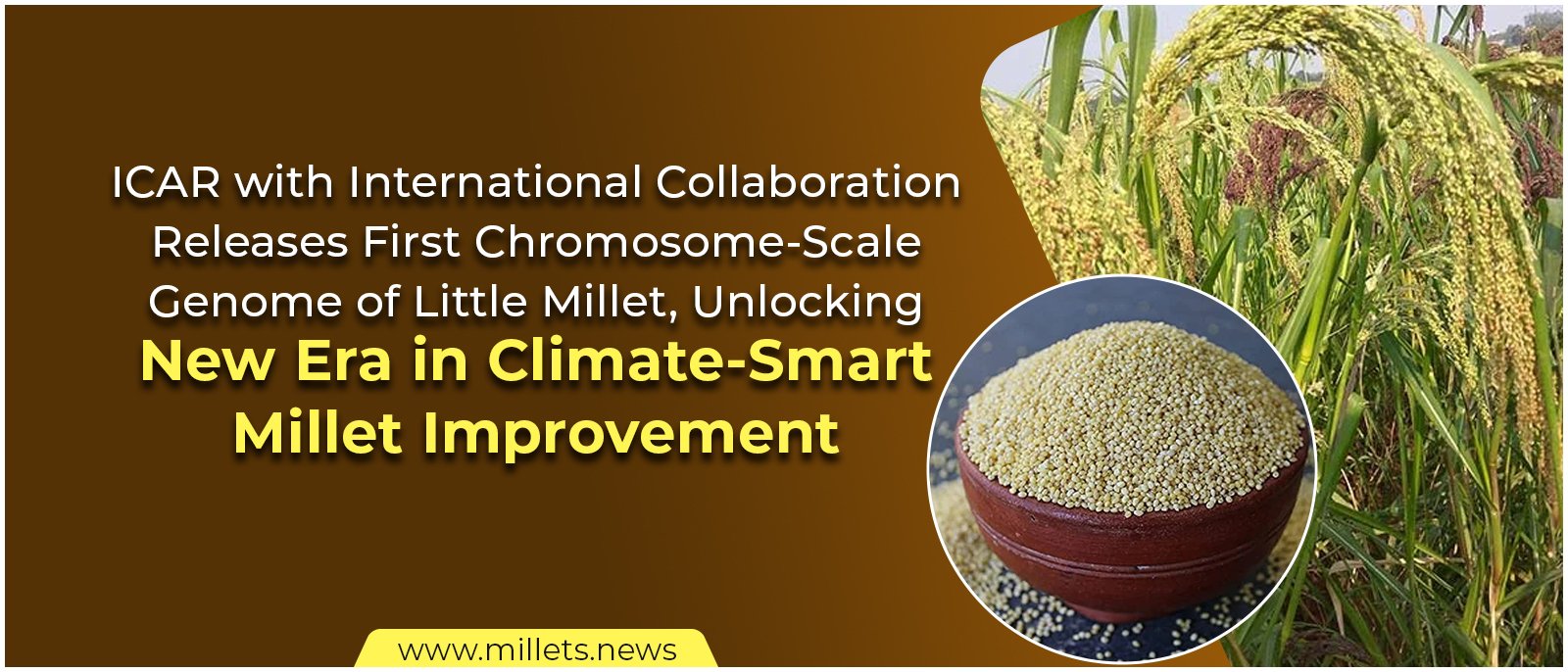
The Indian Council of Agricultural Research (ICAR), in collaboration with leading institutions in Canada and India, has successfully decoded and released the world's first chromosome-scale reference genome of little millet (Panicum sumatrense).
The research was led by the Global Centre of Excellence on Millets (Shree Anna) at the ICAR–Indian Institute of Millets Research (IIMR), Hyderabad, and has been published in Nature Communications. This milestone provides a powerful genomic resource to accelerate the development of climate-resilient, nutrient-rich little millet varieties.
Researchers used advanced long-read and short-read sequencing technologies to assemble the genome of the JK-8 genotype across 18 chromosomes, identifying nearly 59,000 protein-coding genes associated with important traits such as stress tolerance, grain quality, and nutritional value. The team also analysed 300 little millet varieties collected from across India, discovering around 250,000 genetic markers that will help breeders improve yield, nutritional quality, and climate adaptability through modern breeding techniques.
The breakthrough is expected to significantly strengthen efforts to develop superior little millet varieties using molecular breeding, marker-assisted selection, genomic selection, and gene-editing technologies. As a naturally drought-tolerant, nutrient-dense, and gluten-free crop, little millet has growing importance in addressing food security, climate resilience, and micronutrient deficiencies. The achievement further reinforces India's global leadership in millet research and supports the country's long-term vision of promoting climate-smart agriculture.