 By Admin
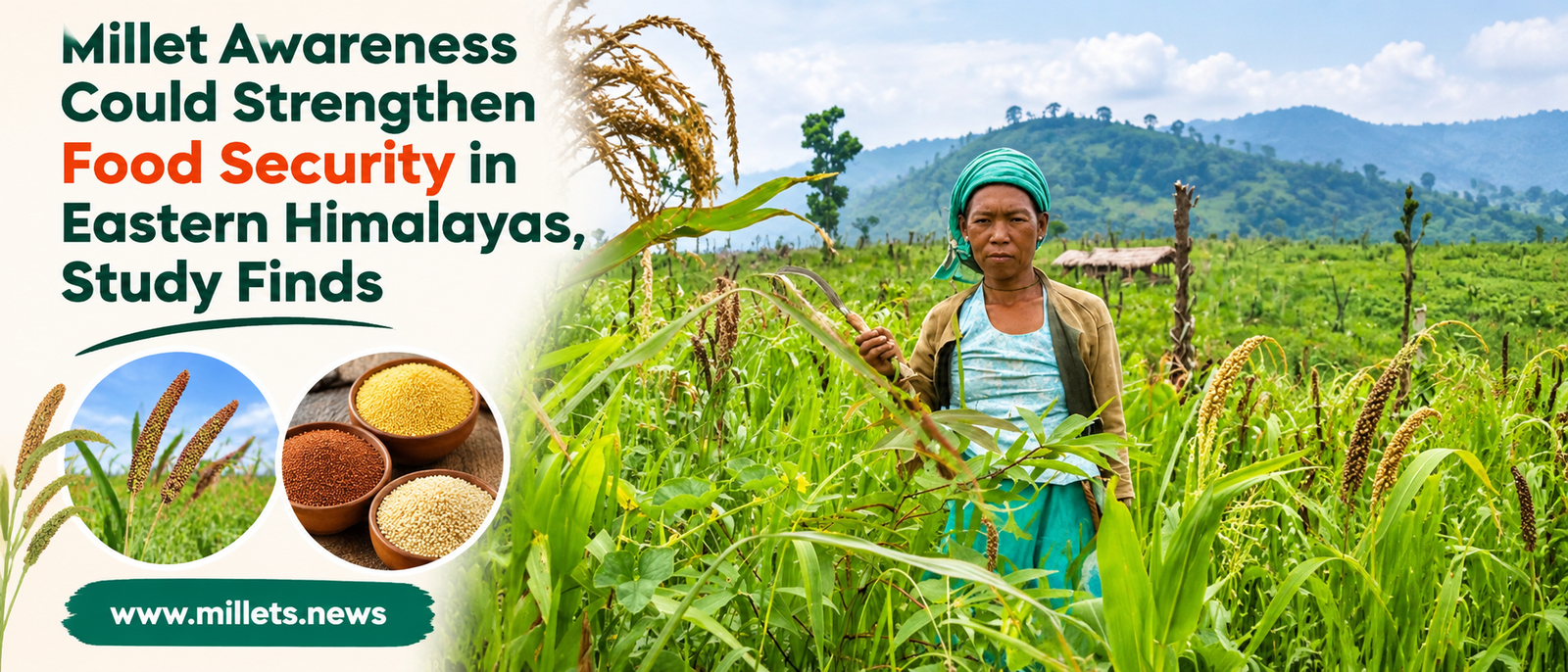
A new scientific study has highlighted the potential of millets to strengthen food security and sustainable livelihoods among indigenous communities in India's Eastern Himalayan region, while identifying important factors influencing their cultivation and consumption.
Published on November 2, 2026, in the peer-reviewed journal Discover Food, the research examines how awareness, education, occupation and health consciousness influence attitudes towards millets.
The study, titled Study on Understanding of Millets for the Indigenous Communities of Eastern Himalayan Region, India, was conducted by a research team led by Th. Motilal Singh, with researchers affiliated with agricultural institutions across Northeast India.
Millets have long been cultivated by indigenous farming communities in the region and remain connected to traditional agricultural practices and food cultures.
Despite their historical importance and adaptability to local conditions, millet production faces constraints that limit its potential contribution to regional food security.
To understand these challenges, the researchers investigated factors affecting millet acceptance among respondents in the Eastern Himalayan region.
They used multinomial logistic regression, a statistical method that examines relationships between several explanatory factors and different categories of outcomes.
The analysis identified age, education level, occupation and health consciousness as important influences on millet-related attitudes and behaviour.
One of the study's key findings was a significant association between awareness of millet benefits and adoption.
The researchers reported that 82.2% of respondents acknowledged the health benefits of millets, suggesting that nutritional awareness was relatively widespread among the surveyed communities.
However, recognising the benefits of a crop does not necessarily mean that it is consistently cultivated or consumed.
The study also found that 68.88% of respondents had received training or demonstrations concerning millet cultivation and nutritional value.
This finding indicates that agricultural extension activities have reached many respondents, although opportunities remain to improve access to relevant information and practical support.
Consumer preferences were another important dimension of the research.
Approximately 55.6% of respondents expressed a preference for millet-based value-added products, indicating potential interest in processed and convenient millet foods.
This finding may be relevant to entrepreneurs, farmer organisations and food processors developing products for regional markets.
The researchers emphasised that interventions should be adapted to the needs of different demographic groups rather than applying a single approach across all communities.
For example, differences in education, occupation and health awareness may influence how people respond to information about millet cultivation and consumption.
The study also draws attention to the broader importance of connecting agricultural production with food preferences and livelihood opportunities.
Increasing millet cultivation alone may not ensure sustained adoption unless farmers and consumers also have access to suitable information, products and market opportunities.
Similarly, promoting the nutritional value of millets may be more effective when accompanied by practical demonstrations and locally relevant food-processing initiatives.
For policymakers and agricultural extension organisations, the findings provide a basis for designing more targeted millet promotion programmes.
These could include community-specific awareness campaigns, farmer training and support for developing value-added millet products.
However, the research identifies statistical associations rather than proving that awareness programmes directly cause increased millet consumption or improved food security.
Further evaluation would be needed to measure the long-term effects of particular interventions on cultivation, dietary patterns and household livelihoods.
For the wider millet sector, the study highlights an important principle: successful millet promotion depends not only on the agricultural characteristics of the crops, but also on the knowledge, preferences and socioeconomic circumstances of the communities expected to grow and consume them.
By identifying these factors, the research contributes to efforts to develop more inclusive approaches to millet adoption and strengthen the role of traditional grains in regional food systems.