 By Admin
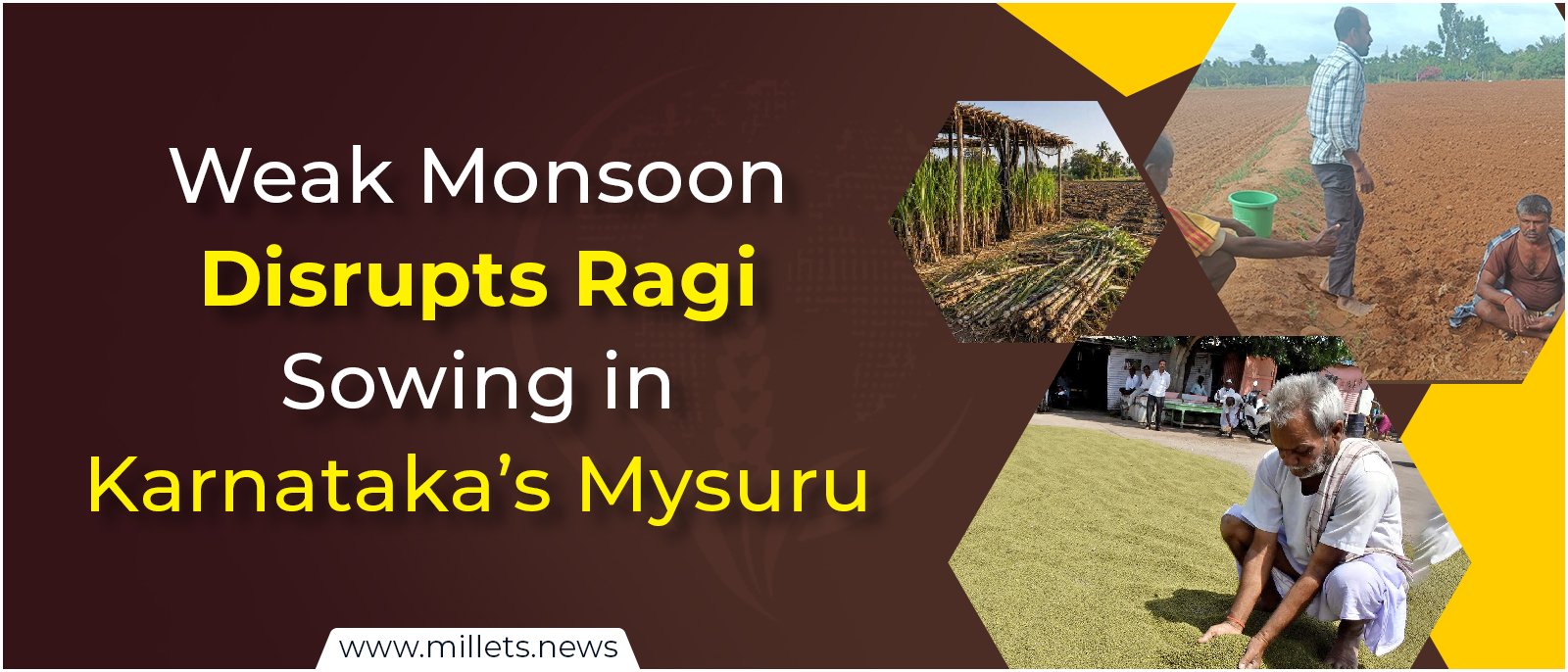
A prolonged rainfall shortage is putting the kharif season under increasing pressure in Mysuru district, Karnataka, where farmers are struggling to complete sowing across large areas. Finger millet, locally known as ragi, is among the important food crops affected by the weak southwest monsoon. The situation highlights how severe moisture shortages can challenge even crops widely valued for their resilience.
Mysuru has experienced one of Karnataka's sharpest rainfall deficits during the current southwest monsoon. By August 8, the district had received 58% less rainfall than normal, making it the state's second-worst affected district after Vijayanagara. The shortage has particularly affected rain-fed agriculture, while limited reservoir releases have further constrained cultivation on irrigated land.
The impact can be seen in the district's overall sowing progress. Farmers had cultivated about 44.1% of the targeted area, compared with 59.3% during the corresponding period last year. Of more than one lakh hectares targeted under irrigation, only 9,211 hectares had been sown, while approximately 1.5 lakh hectares of the targeted 2.7 lakh hectares of rain-fed land had been covered.
Earlier in the season, authorities had encouraged farmers to consider ragi, maize and other drought-tolerant crops as alternatives to water-intensive paddy. The district's ragi cultivation target had consequently been raised from around 62,000 hectares last year to nearly 80,000 hectares this season. Farmers were attracted by ragi's comparatively lower water requirements, livestock-fodder value and favourable market returns.
The persistence of dry conditions, however, demonstrates that drought tolerance has limits. Millets can generally withstand moisture stress better than many water-intensive cereals, but successful establishment still depends on receiving sufficient rainfall during critical stages. Delayed or inadequate precipitation can therefore disrupt sowing and ultimately influence yields even in relatively resilient cropping systems.
The situation also has potential implications for consumers. Farmers quoted by TOI expressed concern that reduced cultivation of ragi and paddy could eventually place upward pressure on prices. Meanwhile, maize has performed considerably better in sowing terms, reaching 48,725 hectares against a target of 49,523 hectares.
Mysuru's experience illustrates an increasingly important challenge for climate-resilient agriculture. Promoting millets can help farming communities adapt to water scarcity, but resilient crops alone cannot eliminate the consequences of extreme rainfall deficits. Water management, suitable varieties, timely weather information and locally adapted contingency planning will remain essential for protecting millet production under increasingly unpredictable monsoon conditions.