 Millets National Media Portal
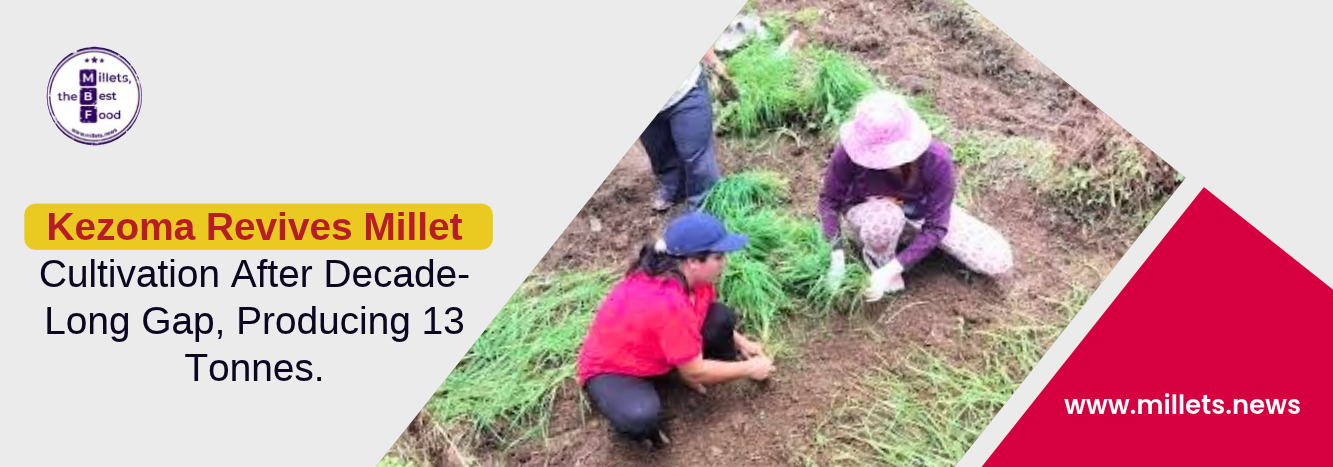
Kezoma village in Kohima district, Nagaland, has successfully revived its traditional millet cultivation after more than a decade-long gap, with estimated production reaching 12–13 tonnes in 2026. The achievement highlights the importance of community participation, agricultural mechanisation and government support in restoring traditional farming practices while creating new economic opportunities for rural farmers.
The millet revival initiative began in 2024 through a collaborative effort by the District Agriculture Office, Kohima, and the Kezoma Village Council. Seeds collected from different parts of Nagaland were distributed among farmers, while awareness programmes encouraged villagers to resume cultivating the traditional crop. According to the District Agriculture Office, millet farming had remained discontinued in Kezoma for over ten years, leaving a generation of children unfamiliar with the crop's traditional role in local agriculture.
The initiative initially faced challenges in motivating farmers to return to millet cultivation. Starting from zero hectares, the village brought approximately one hectare under cultivation in 2024. A significant breakthrough came when the District Agriculture Office provided a millet mill to support post-harvest processing. The equipment reduced manual labour and processing difficulties, with the department estimating an 80% reduction in post-harvest labour drudgery. Easier processing encouraged more farmers to participate and helped expand cultivation in subsequent years.
In 2025, Kezoma organised its first millet festival to promote traditional grains, increase public awareness and create market opportunities for local farmers. The event showcased approximately 4,000 kg of millet grain and value-added products. According to the department, sales generated around Rs 13–14 lakh in a single day, demonstrating the commercial potential of locally produced millets. By 2025, the area under millet cultivation had expanded to two hectares, with reported productivity ranging between 20 and 25 quintals per hectare.
The revival gained further momentum in 2026, when the cultivated area reportedly doubled again. The District Agriculture Office estimated total millet production at approximately 12,000–13,000 kg, with average yields ranging from 2,000 to 2,500 kg per hectare. To strengthen processing facilities, the department provided the village with a millet thresher and an additional millet mill, helping farmers manage harvesting and processing more efficiently.
Beyond the main agricultural season, the initiative is also exploring opportunities for cultivating millet twice a year. Experimental second-season cultivation began in 2025 and produced encouraging results. In 2026, approximately two hectares were brought under the second-season crop, with harvesting expected in November. To address water shortages and support additional cultivation, a sprinkler irrigation system was provided under the Per Drop More Crop (PDMC) component of the Pradhan Mantri Krishi Sinchayee Yojana.
Kezoma's experience demonstrates how traditional millet cultivation can be restored through farmer engagement, improved agricultural infrastructure, irrigation facilities and local marketing initiatives. The village's progress from zero cultivation in 2024 to an estimated 12–13 tonnes of production in 2026 highlights the potential of millets to strengthen rural livelihoods, promote sustainable agriculture and create new income opportunities for farming communities in Nagaland.
© 2023 - 2026 Millets News. All rights reserved.

