 By Admin
Scientists studying plant remains recovered from an ancient Chinese tomb have uncovered compelling evidence that millets formed part of sophisticated grain-wrapping traditions more than two millennia ago.
A research team led by Dr. Yong Ge of the Institute of Vertebrate Paleontology and Paleoanthropology, Chinese Academy of Sciences, and Dr. Fan Yang of the National Center for Archaeology conducted systematic archaeobotanical analyses of plant bundles excavated from the Wuwangdun Tomb.
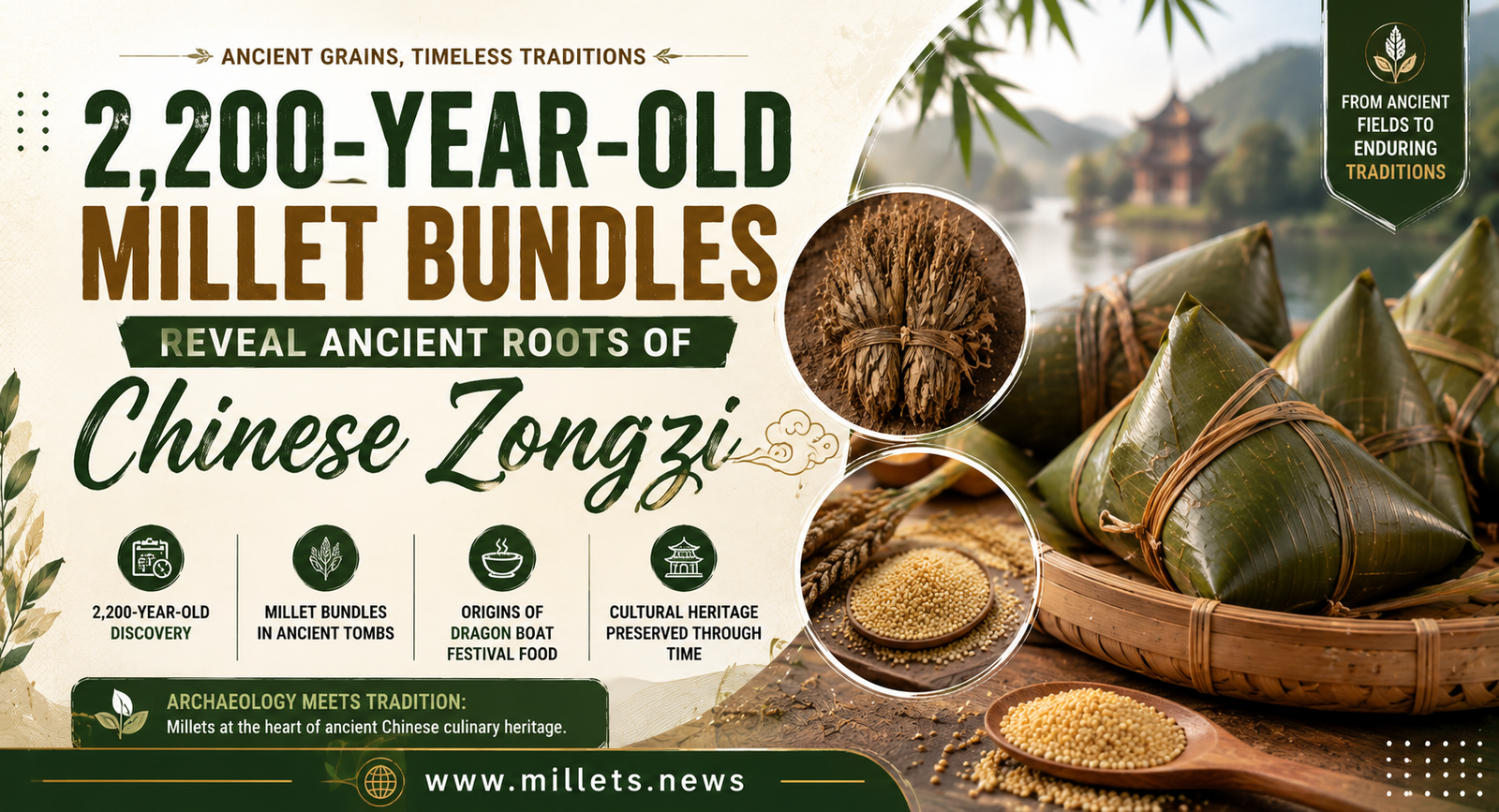
Dating to approximately 2,200 years ago, the bundles were wrapped in oak (Quercus dentata) leaves and contained several cereals, including rice (Oryza sativa), broomcorn millet (Panicum miliaceum) and foxtail millet (Setaria italica).
Grass-leaf cordage was used to bind the bundles. Their overall construction bears a notable structural resemblance to zongzi, the traditional Chinese leaf-wrapped food now commonly prepared with glutinous rice and various fillings.
However, the researchers identified an important distinction.
The ancient grains remained unhulled, while inflorescence material was also preserved inside the bundles. This suggests that the archaeological specimens were probably not prepared for eating. Instead, researchers interpret them as funerary offerings.
Their age makes the discovery particularly significant. Before this research, unequivocal archaeological evidence for typical zongzi was known from a tomb dating to approximately 1,000 years ago during the Song Dynasty.
If the Wuwangdun bundles represent an ancestral form of the tradition, they could potentially push archaeological evidence for zongzi-like grain bundles back by roughly another millennium.
The discovery also has an intriguing cultural context. The bundles date to the historical period of the Chu State and originate from the broader geographic region associated with the legend of Qu Yuan. Traditional narratives surrounding Qu Yuan subsequently became closely associated with zongzi and the Dragon Boat Festival.
Researchers therefore see an interesting convergence between archaeological evidence, historical traditions and later cultural narratives, although the bundles themselves should not simply be described as modern zongzi.
For millet history, the discovery is particularly noteworthy. Both broomcorn millet and foxtail millet are among Eurasia's ancient domesticated cereals, and their presence alongside rice in these carefully constructed funerary bundles demonstrates their cultural significance beyond ordinary agricultural production.
The findings provide another archaeological window into the longstanding relationship between millets, food traditions and human culture in China.
The research was published in National Science Review.