 By Admin
Archaeological investigations in China are providing new insights into the early history of millet cultivation and the transition from hunting and gathering to settled agriculture.
According to a report published by Science and Technology Daily on October 13, 2026, researchers have combined plant-remain analysis, isotope studies, ancient DNA and soil investigations to reconstruct prehistoric farming practices.
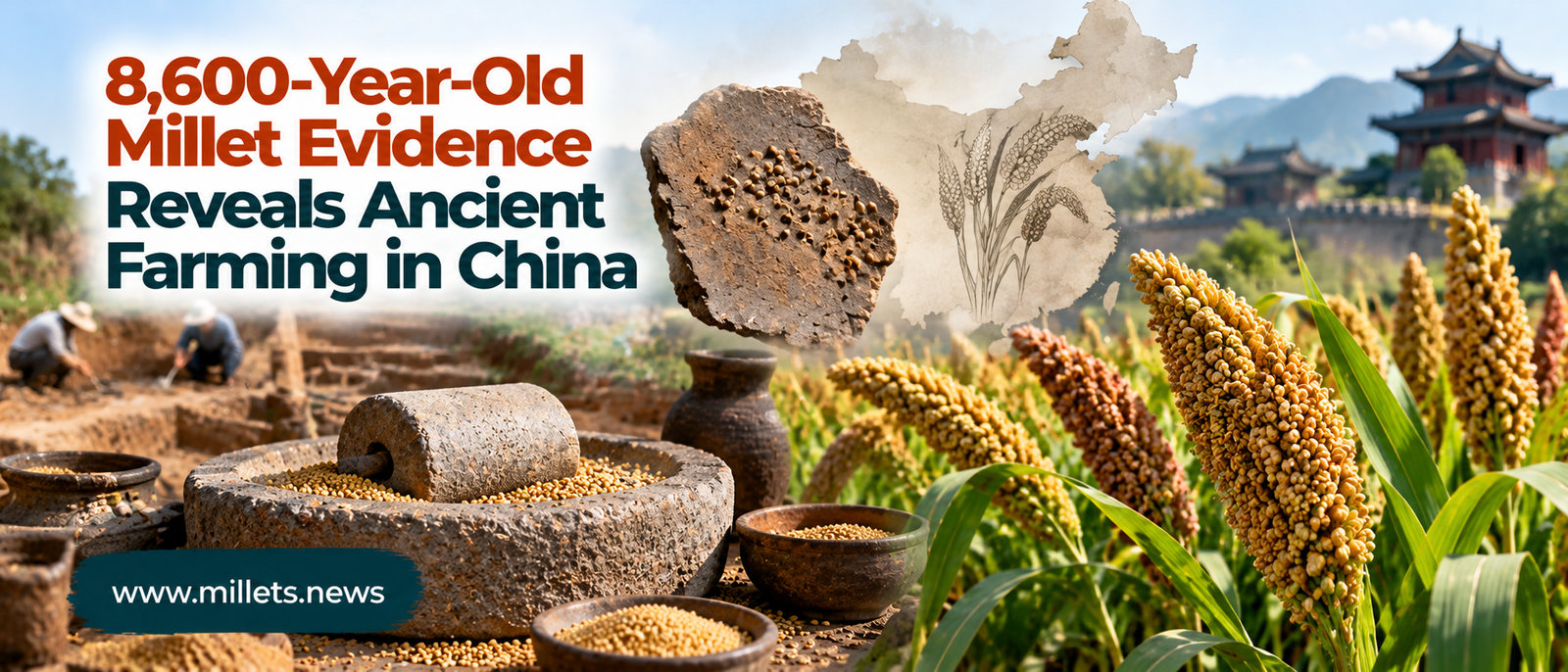
At the Xinglong archaeological site in Hebei province and the Simagou site in Inner Mongolia, researchers recovered traces of foxtail millet dating back approximately 8,600 years.
Additional discoveries at the Sitai site in Hebei and the Yumin site in Inner Mongolia revealed remains of broomcorn and foxtail millet dating to around 7,700 years ago.
These discoveries provide evidence of the importance of millets in the development of early agriculture across northern China.
Stable carbon isotope analysis has also helped researchers understand changes in prehistoric diets.
Around 9,000 years ago, communities in the Bashang plateau region, near the border of Hebei and Inner Mongolia, depended largely on hunting, gathering and plants associated with C3 photosynthesis.
By approximately 7,500 years before present, C4 plants, including millets, had become more prominent in local diets.
Researchers examined isotope signatures preserved in human and animal remains to trace this dietary transition.
Ancient genomic evidence also suggests continuity in local populations, supporting the interpretation that millet farming developed through local agricultural processes rather than necessarily resulting from population replacement.
The research further explores how early farming communities managed agricultural land.
A team led by Shang Xue of the University of Chinese Academy of Sciences investigated ancient millet cultivation on China's Loess Plateau.
Through experimental reconstruction, botanical analysis, soil studies and isotopic techniques, researchers identified evidence that early farmers differentiated agricultural soils according to elevation, fertility and moisture availability.
The findings also indicate intentional fertilisation of farmland along the Yellow River during the middle-to-late Neolithic period.
These practices suggest that prehistoric farming communities developed knowledge of soil conditions and adapted agricultural techniques to their local environments.
The broader archaeological investigations also examined ancient water management, rice domestication and mixed hunting-farming systems across different regions of China.
For millet research, the findings are particularly relevant because they help explain how foxtail and broomcorn millet became established crops within prehistoric agricultural systems.
The discoveries demonstrate the contribution of traditional grains to early food production and provide insights into the long history of agricultural adaptation in northern China.
Research caution: The source summarises several archaeological investigations rather than presenting one newly published, peer-reviewed millet study. The 8,600-year date refers to recovered millet traces, not proof that fully developed millet agriculture existed at that exact time.