 By Admin
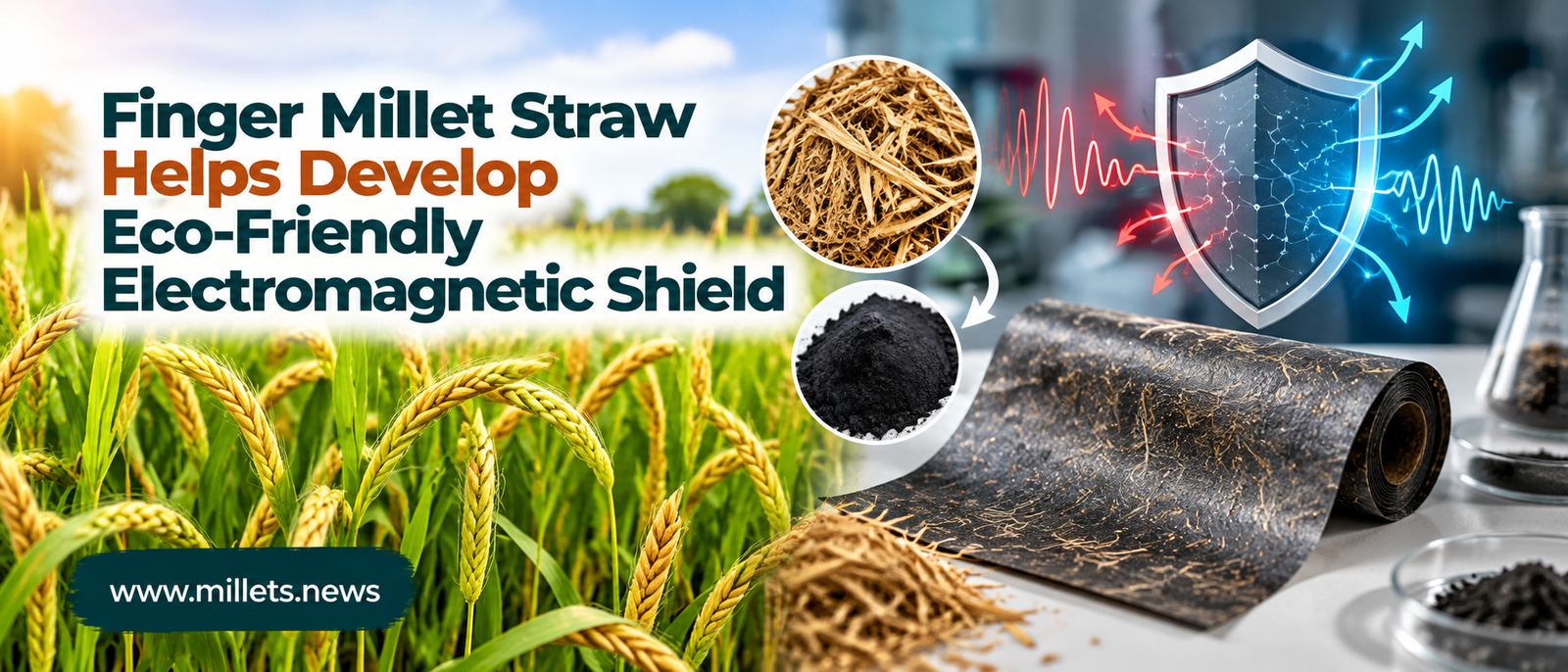
Researchers in India have demonstrated a new application for finger millet agricultural waste by incorporating ragi straw microfibres into a polymer composite designed to reduce electromagnetic interference.
The study, published in Polymer Bulletin, explores how agricultural residues can be converted into functional materials for electronic shielding applications.
Led by S. Ramesh of Rajalakshmi Engineering College, the research team combined microfibres extracted from finger millet straw (Eleusine coracana) with activated biocarbon produced from soybean hulls.
The researchers incorporated both materials into a polyvinyl alcohol (PVA) polymer matrix to produce lightweight composite films.
Finger millet straw was treated to isolate cellulose-rich microfibres, while soybean hulls were processed into porous activated biocarbon. A silane coupling agent was used to improve bonding between the agricultural fillers and the polymer.
The composite films were then prepared using a solution-casting method and tested for mechanical strength, dielectric properties and electromagnetic shielding performance.
The strongest-performing formulation, identified as P4, achieved a total shielding effectiveness of 38.3 dB in the 10–12 GHz microwave frequency range.
Of this performance, 30.8 dB was attributed to absorption and 7.5 dB to reflection, indicating that the material primarily attenuated electromagnetic waves through absorption rather than reflecting them.
The study also found that increasing biocarbon content improved tensile strength, tear strength and hardness, although the material became less flexible.
These findings are significant for agricultural residue utilisation because finger millet straw is generally treated as a low-value by-product after grain harvesting.
Converting such residues into specialised materials could create additional opportunities for biomass-based manufacturing and agricultural value addition.
The researchers suggest that the composite may have potential for electromagnetic interference shielding in electronic applications. However, the material remains at the experimental stage.
Further work is required to evaluate long-term durability, moisture resistance, manufacturing consistency and commercial-scale production.
The research demonstrates how finger millet biomass could contribute to material innovation beyond the crop's established food and agricultural uses.