 By Admin
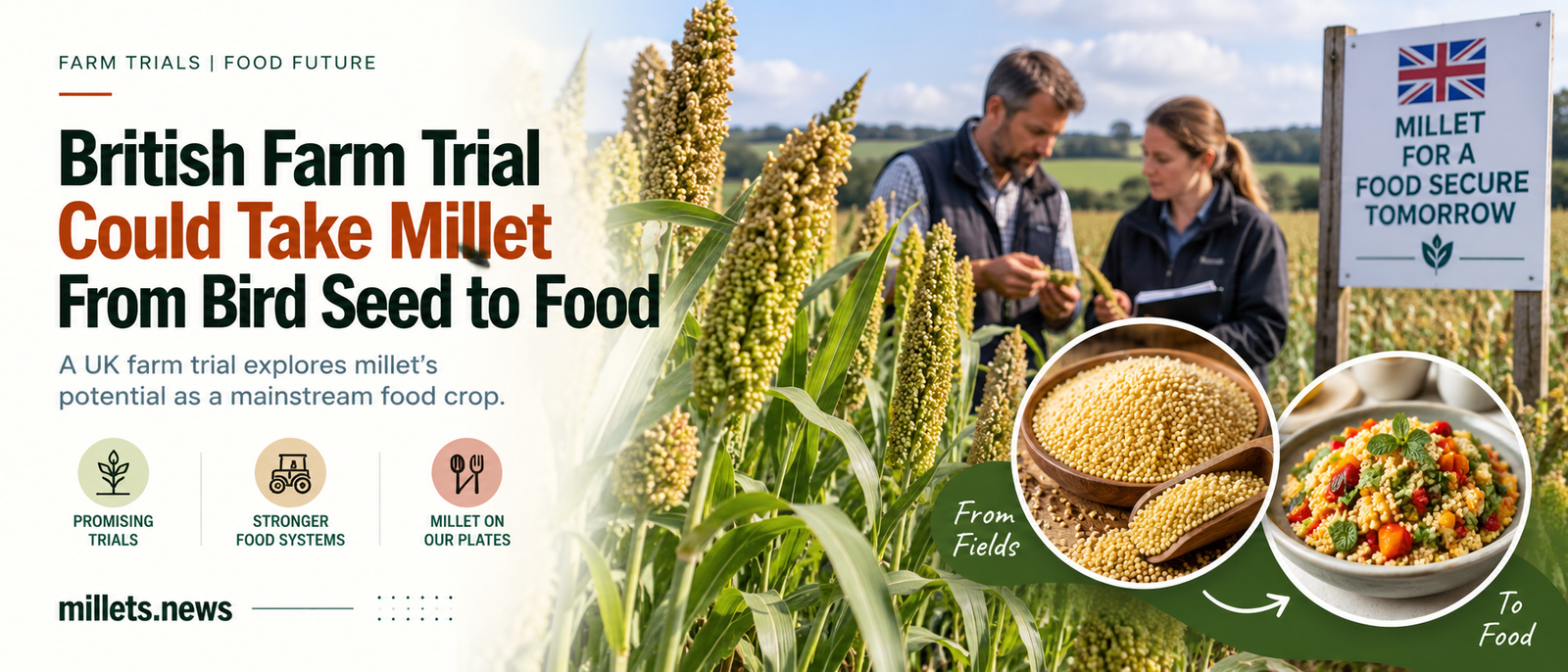
A farmer-led trial in southern England is exploring whether millet can move beyond its established British market for wild bird seed and become a commercially viable grain for human consumption.
At Nonington Farms near Canterbury in Kent, grower Emma Loder-Symonds is cultivating millet as part of a project supported through Defra's Accelerating Development of Practices and Technologies (ADOPT) funding. The programme supports farmer-led trials designed to test practical agricultural innovations.
The project was inspired by chef Dev Biswal, who operates The Cook's Tale restaurant in Canterbury. Loder-Symonds already supplies him with heritage wheat flour, and the collaboration is now examining millet's potential as another locally produced food ingredient.
The trial is particularly significant because millet grown commercially in the UK has traditionally been associated with bird-seed and environmental uses rather than food markets. Establishing food-grade production would therefore require solutions across cultivation, harvesting, processing and consumer demand.
This season, Loder-Symonds drilled 5.6 hectares of Proso white millet on May 15, intercropping it with spring beans. The crop received 40kg/ha of nitrogen at drilling. Despite very dry conditions—with the farmer reporting no rain since June—the millet remained notably resilient.
Harvesting presents one of the project's most important technical questions. Millet intended for bird seed is commonly desiccated before harvest, but food-grade production faces considerably stricter residue requirements. Researchers are consequently examining swathing as an alternative harvesting strategy.
The field will be divided into four treatments. One section will be directly combined, while three others will be swathed and harvested after five, 10 and 15 days, allowing the project to investigate an appropriate harvest window.
Processing presents another challenge. Millet needs effective dehulling for palatable human food, and the project is investigating whether equipment can be integrated with the farm's existing stone-milling operation.
Researchers at NIAB, meanwhile, are examining a micro-malting technique involving controlled germination. The approach is intended to activate the grain's own enzymatic processes and reduce the nutritional limitations associated with phytic acid without allowing full root and shoot development.
If successful, the resulting grain could potentially serve as a whole-food ingredient, while micro-malted millet could also have applications in brewing. Chef Dev Biswal is expected to demonstrate different culinary applications once processing trials progress.
The project is also exploring millet diversity. Proso white millet forms the principal trial crop, but Loder-Symonds has experimented on a small scale with two foxtail millet types. Their establishment has encouraged consideration of more extensive trials in the future.
Year-two research could examine earlier drilling, different companion-cropping strategies, additional millet types and the performance of winter wheat following millet.
Ultimately, commercial viability will depend on more than successful cultivation. Researchers emphasise that a dependable market must exist before farmers can confidently adopt a new food crop.
If those agronomic, processing and market challenges can be addressed, the Kent experiment could provide an important demonstration of how climate-resilient millets can diversify British cropping systems while supplying new food markets.