 By Admin
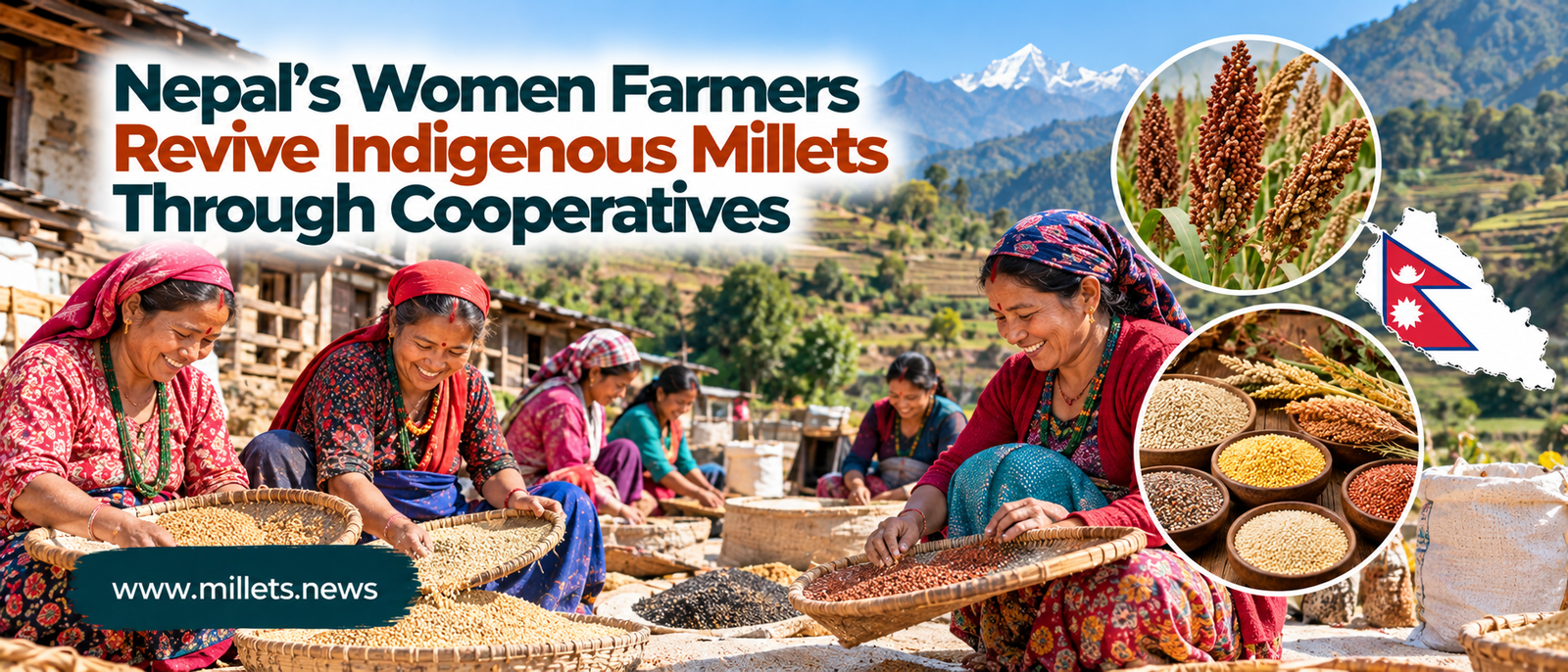
Women farmers in Nepal's mountainous Jumla district are strengthening the commercial potential of indigenous millets by combining traditional cultivation with cooperative marketing, improved agricultural equipment and local food processing.
A report published by Nepal News on October 16, 2026, highlights how proso millet, locally known as Chino, is moving beyond small household plots into organised production systems.
In Syalbada, Chandannath Municipality–8, farmers have established a collective proso millet cultivation block covering approximately three hectares. The initiative is supported by the Renewable Energy for Resilient Agri-Food Systems (RERAS) project.
The local Indigenous Crop, Fruit and Vegetable Production Group has 27 women members who are working to increase production and develop more reliable market connections.
Among the participating farmers is Rajkanya Rokaya, who previously cultivated Chino mainly for household consumption. With improved seeds, technical assistance and collective farming support, she and other farmers are exploring opportunities to sell more of their produce.
The initiative also supports better manure management and the use of agricultural equipment.
An energy-operated multi-crop thresher has helped reduce the labour involved in harvesting and processing millet, making production more manageable for farming households.
Market access is another important development.
In Tatopani Rural Municipality, the women-led Dhauligad Agriculture Cooperative purchases indigenous grains from local farmers, including those producing relatively small quantities.
Farmer Batuli Sarki sold 70 kilograms of proso millet and 75 kilograms of foxtail millet during fiscal year 2025/26, earning NPR 6,300 and NPR 6,750 respectively.
The cooperative reported that procurement prices for both crops had increased from NPR 90 to NPR 100 per kilogram for the current year.
Its community seed bank also supports the conservation and circulation of indigenous crop varieties. During fiscal year 2025/26, the cooperative sold 14 tonnes of seeds to farmers in Jumla and other districts.
Beyond cultivation, local entrepreneurs are creating value-added foods using traditional grains.
In Khalanga, Black Stone Bakery produces cakes, bread and cookies using millet, buckwheat and wheat.
The business purchases ingredients from local farmers through a cooperative and supplies products to nearby districts.
Support from the RERAS project has helped the bakery improve its production capacity through upgraded equipment.
The wider project, supported by international development partners, aims to strengthen food systems through indigenous crops, agricultural technology, nutrition and renewable energy.
For Nepal's millet sector, the developments in Jumla demonstrate how farmer groups, seed conservation, mechanisation and local processing can help reconnect traditional grains with commercial opportunities.
The experience also highlights the role of women-led organisations in sustaining indigenous crop cultivation while creating additional income opportunities in mountain communities.