 By Admin
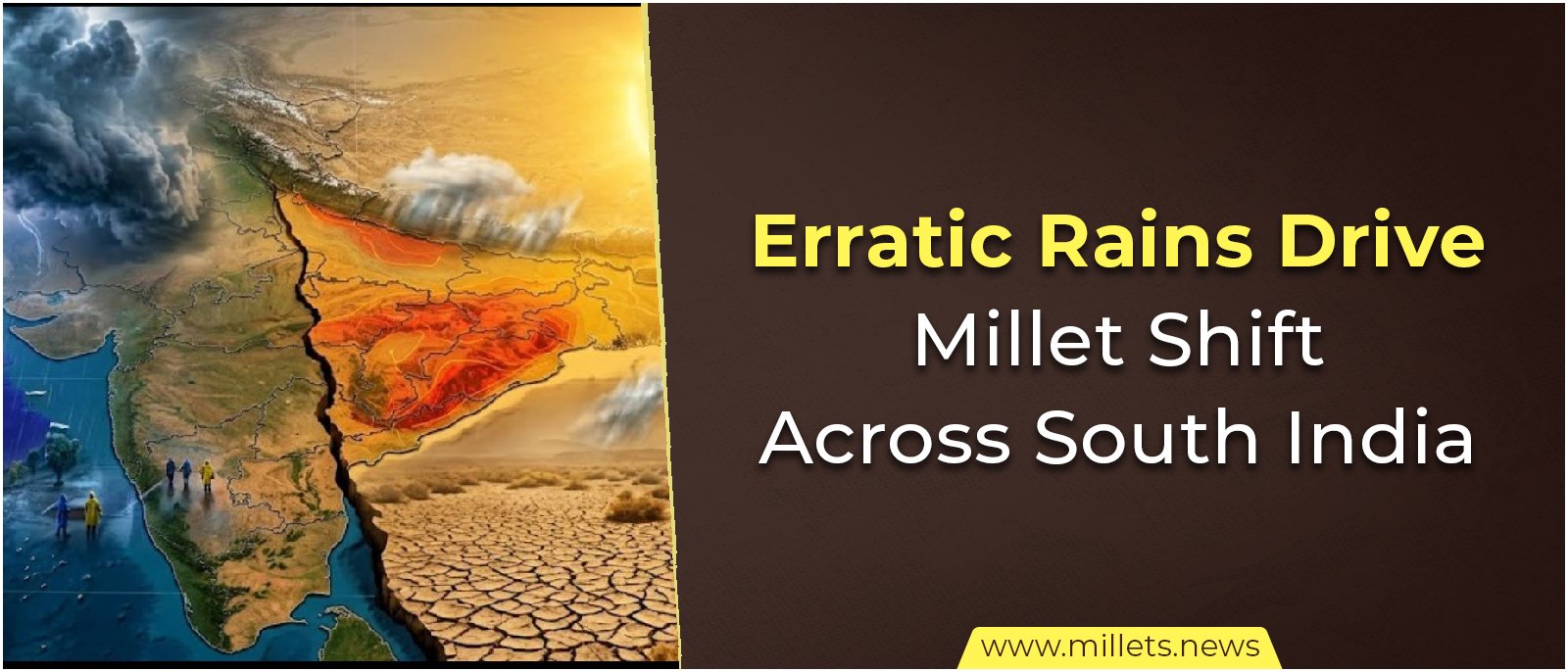
Increasing rainfall uncertainty across southern India is reinforcing the need for agricultural systems that can withstand water scarcity and unpredictable monsoon conditions.
The article highlights a significant rainfall deficit in the South Peninsula during 2026. By July 29, cumulative rainfall stood at 259.7 mm against the normal 353.1 mm, representing an overall deficit of approximately 26%. Such irregular rainfall can delay sowing, reduce crop productivity and increase risks for farmers dependent on rainfed agriculture.
Against this backdrop, millets emerge as important climate-adaptation crops. Farmers in dryland areas already cultivate relatively low-water-demand crops including millets, pulses and oilseeds. The article recommends matching crops with local soil characteristics and rainfall availability rather than applying a uniform cropping strategy across southern states.
For millet cultivation specifically, bajra (pearl millet) is identified as appropriate for very dry and light soils, while jowar (sorghum) can perform in dry black and red soils.
Intercropping provides another opportunity for resilience. Suggested combinations include pearl millet with red gram, foxtail millet with red gram, ragi with red gram, and sorghum with pigeon pea. Such diversified systems can help farmers make better use of available soil moisture while reducing dependence on a single crop.
The article also recommends region-specific technologies such as watershed development, micro-irrigation, farm ponds, soil-moisture sensors, precision agriculture, remote sensing and rainwater storage across Andhra Pradesh, Telangana, Karnataka, Tamil Nadu and Kerala.
Ultimately, climate-resilient farming will require more than changing crops. The article argues for economic incentives, quality seeds, water-conservation technologies, crop insurance, assured markets and stronger farmer-producer organisations to facilitate a transition away from water-intensive crops where agro-climatic conditions warrant it.
For the millet sector, the central message is significant: pearl millet, sorghum, finger millet and foxtail millet can become increasingly important components of climate-adaptive farming systems across South India.