 By Admin
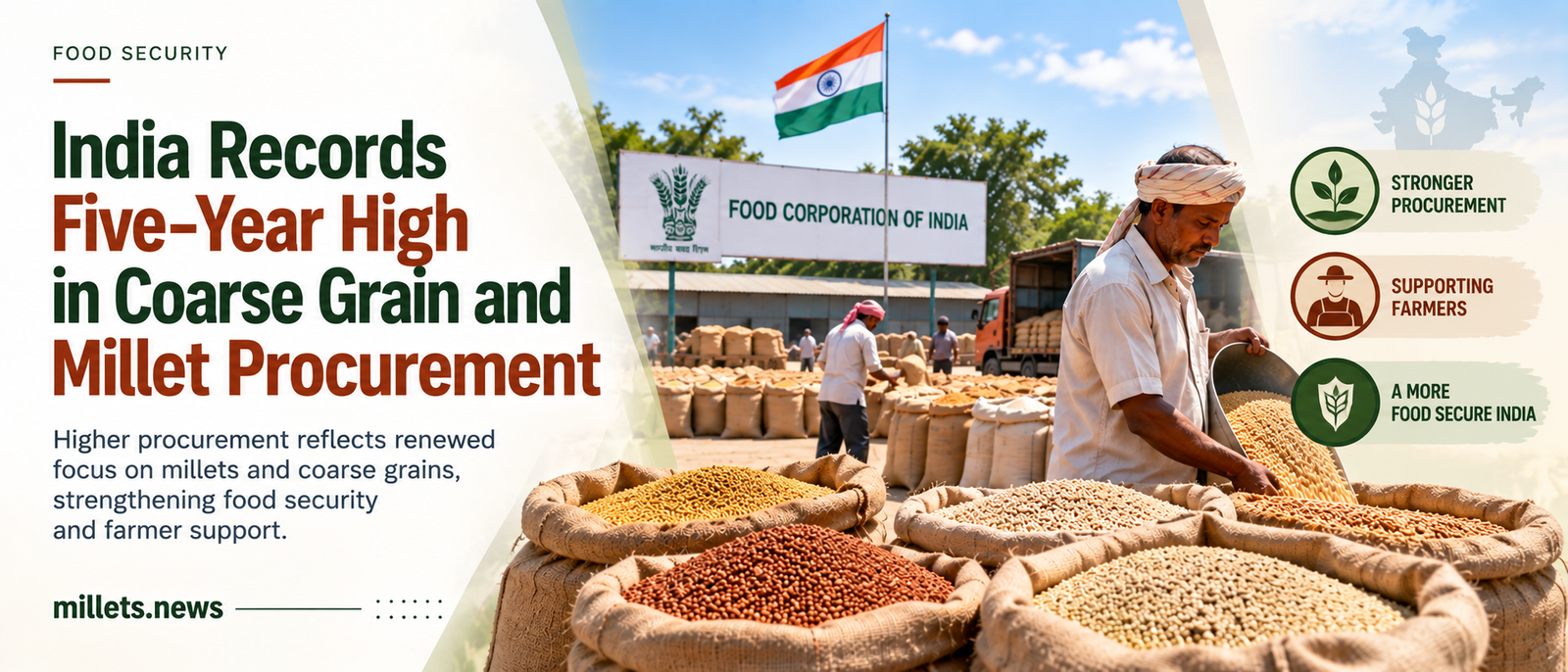
India has recorded its highest procurement of coarse grains and millets in five years, marking an important development for crops that include several of the country's major nutri-cereals.
The Department of Food and Public Distribution (DFPD) said 16.38 lakh metric tonnes (LMT) of coarse grains and millets were procured during 2025–26, the highest quantity recorded over the last five years.
The figures were discussed at a meeting of State and Union Territory Food Secretaries held in New Delhi on September 1, 2026. The meeting, chaired by DFPD Secretary Sanjeev Chopra, reviewed foodgrain procurement, public distribution and storage ahead of the Kharif Marketing Season (KMS) 2026–27.
For the upcoming season, states have estimated procurement of 18.85 LMT of coarse grains during KMS 2026–27 (Kharif). This figure represents the broader coarse-grain category and should not be described as an 18.85 LMT millet procurement target.
Separately, the conference reviewed procurement and distribution plans for coarse grains, millets and minor millets, reflecting continued government attention to these crops within India's foodgrain procurement framework.
The distinction between the two figures is important. The 16.38 LMT figure is an achieved procurement quantity for coarse grains and millets during 2025–26, whereas the 18.85 LMT figure is an estimated procurement quantity for the broader coarse-grain category during KMS 2026–27.
The meeting also recognised states for notable achievements in procurement and food-distribution systems. Karnataka was recognised for Excellence in Procurement of Shree Anna, reinforcing the state's role in institutional procurement of millets. Andhra Pradesh, Punjab and Chhattisgarh were recognised for achievements in other areas of foodgrain procurement and digitalisation.
The development comes alongside higher Minimum Support Prices for several major millet crops for the 2026–27 marketing season. The government has fixed the MSP at ₹4,023 per quintal for hybrid jowar, ₹4,073 for Maldandi jowar, ₹2,900 for bajra and ₹5,205 for ragi.
Bajra carries an estimated 56% margin over the government's calculated cost of production, while the corresponding margin is 50% for hybrid jowar and ragi. The government has said higher MSPs are among the measures being used to encourage crops including nutri-cereals/Shree Anna.
Technology is also becoming a larger part of India's procurement infrastructure. The government reviewed progress under the Procurement Centre Smart-Assessment Portal (PCSAP) and plans to introduce AI-based image validation from KMS 2026–27.
Other digital reforms discussed at the conference included GPS-based real-time tracking of vehicles transporting foodgrains through the Public Distribution System and the expansion of technology-enabled procurement and storage management.
For India's millet sector, the most significant development is therefore not the overall coarse-grain estimate for the coming season, but the fact that combined coarse-grain and millet procurement reached 16.38 LMT in 2025–26 — its highest level in five years.
The figures indicate a strengthening institutional role for these grains within India's procurement system, while the separate 2026–27 coarse-grain estimate provides an indication of states' broader procurement expectations for the upcoming kharif season.