 By Admin
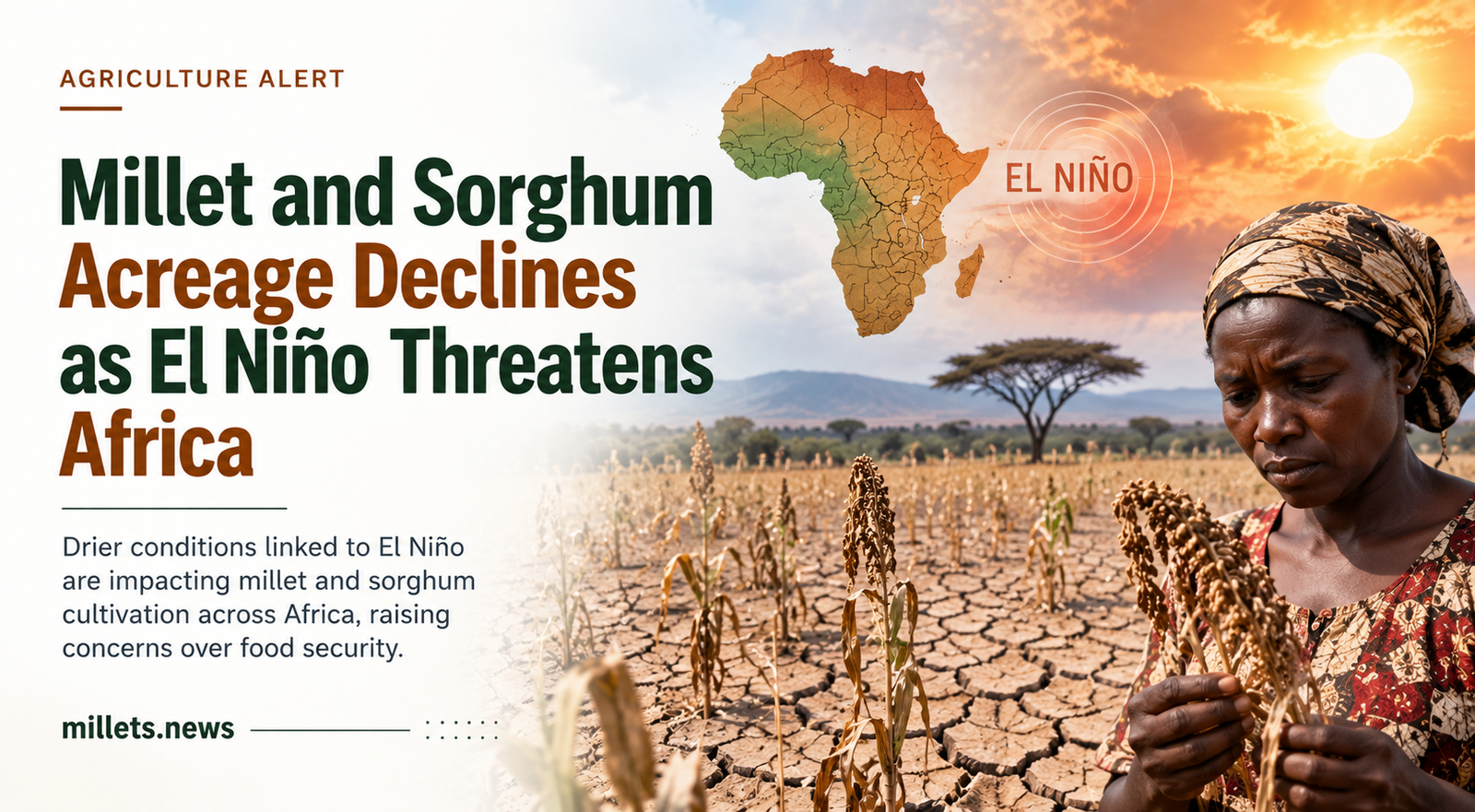
Africa is confronting a growing contradiction in its efforts to build climate-resilient food systems: drought-tolerant crops such as millet and sorghum are increasingly important under extreme weather conditions, yet their adoption has declined relative to maize.
The issue was highlighted as agricultural leaders, researchers and seed-system specialists gathered at the Africa Food Systems Forum in Kigali, Rwanda, amid renewed concern about El Niño and its potential consequences for the continent's 2026–27 farming season.
According to the report, millet and sorghum are among the drought-resistant and nutritious staples capable of helping farmers maintain production through dry periods. However, barriers including limited information, counterfeit seed products and weak distribution networks are constraining wider adoption of improved and climate-resilient varieties.
The scale of the shift is significant. Citing an August report by agricultural policy researcher Timothy Wise of Tufts University, the article says millet and sorghum's combined share of African cropland declined from 25% in 2006 to 17% in 2024. Meanwhile, maize continues to dominate as a staple across much of sub-Saharan Africa.
The decline comes as climate risks intensify.
The World Meteorological Organization has reported that El Niño is strengthening rapidly in the Pacific and is expected to become very strong toward the end of 2026. The likelihood of the phenomenon persisting through February 2027 is now close to 100%, according to the report.
For African agriculture, those conditions raise the risk of drought, extreme heat, flooding and other disruptive weather during the 2026–27 production cycle.
Recent experience demonstrates the potential consequences. During the 2023–24 agricultural season, an El Niño-induced drought affected Southern Africa, contributing to crop failures, water scarcity, livestock losses and worsening food insecurity. The challenge, however, extends beyond developing drought-tolerant varieties.
At the Africa Food Systems Forum, seed-sector specialists emphasised the need to strengthen the systems that move agricultural innovations from research institutions into farmers' fields.
Evelyne Lusenaka of AGRA's Center of Excellence for Seed Systems in Africa identified inadequate early-generation seed, counterfeit products, weak distribution and limited access to information among the obstacles preventing farmers from obtaining improved varieties.
CIMMYT Director General Bram Govaerts similarly highlighted a gap between scientific innovation and practical delivery. Financing, seed systems, markets, extension services, policy and distribution networks all influence whether improved technologies ultimately reach farmers.
The African Development Bank's Technologies for African Agricultural Transformation (TAAT) initiative provides one example of efforts to bridge that gap. The report notes that AfDB's $1.5 billion African Emergency Food Production Facility supported access to quality and climate-resilient seeds across 35 African countries following recent food and fertiliser shocks.
For millet and sorghum, the debate is particularly important. Both crops possess characteristics suited to water-constrained production environments, but their climate resilience alone will not guarantee greater adoption.
Ensuring that farmers can obtain appropriate varieties, reliable seed, agronomic information, finance and market access will be essential if Africa is to translate the potential of climate-resilient grains into stronger food-system resilience.