 By Admin
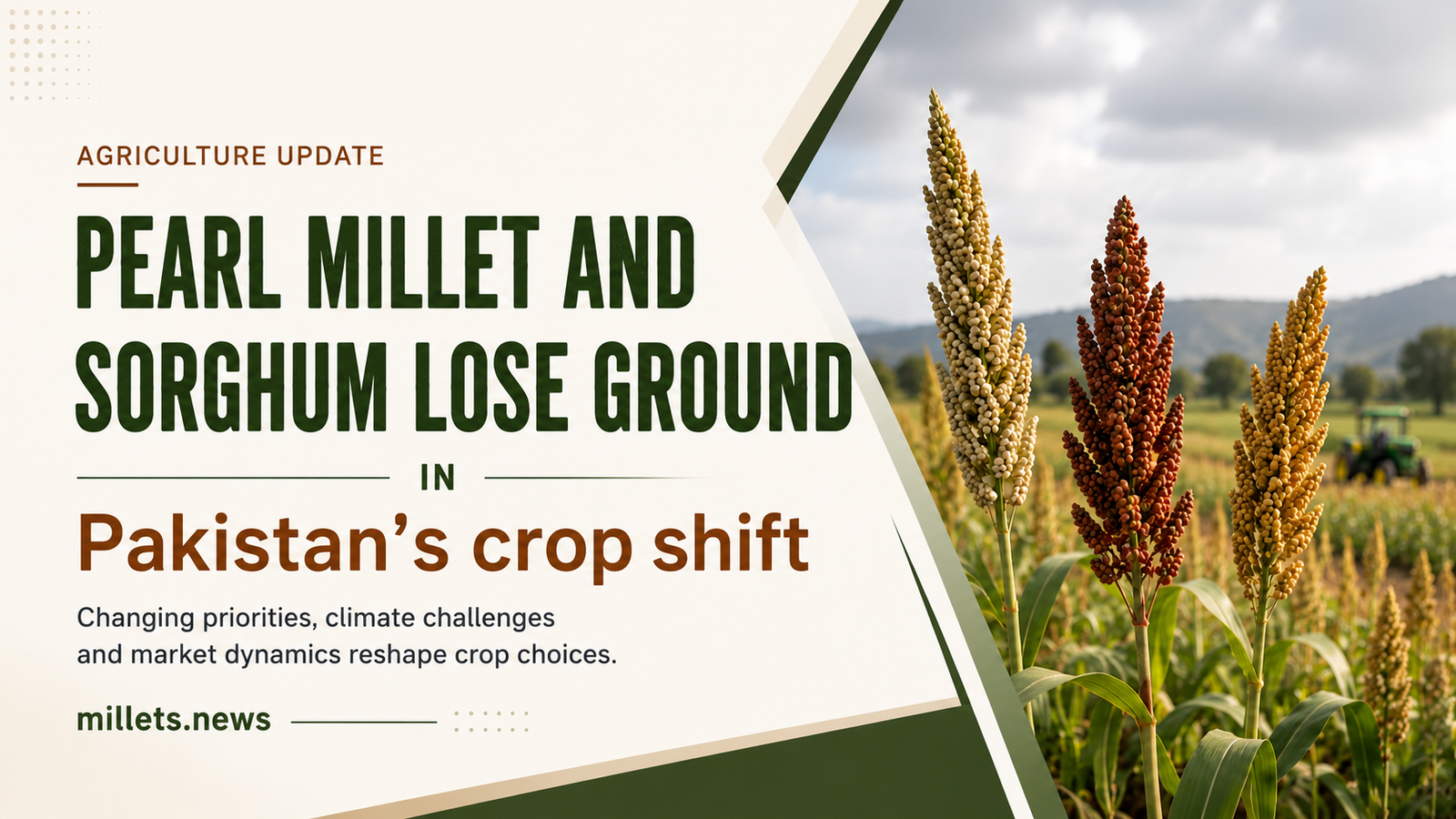
Pakistan's changing agricultural landscape is putting traditional dryland crops such as pearl millet and sorghum under increasing pressure as farmers concentrate production on a narrower group of commercially viable alternatives.
An analysis published by Dawn examines how the substantial contraction of Pakistan's cotton sector over the past decade has reshaped Kharif cropping patterns, particularly in Punjab. Cotton acreage declined from 2.96 million hectares in FY15 to 2.01 million hectares in FY26.
As cotton became less attractive economically, farmers increasingly moved toward sugarcane, rice, maize and sesame. Between FY15 and FY26, the area devoted to sugarcane increased by 7%, rice by 30% and maize by 39%.
Millets have also been affected by this transition.
The analysis reports that the rapid expansion of sesame occurred partly on land previously cultivated with bajra (pearl millet) and jowar (sorghum), with acreage under both crops declining significantly over the 11-year period.
The development raises an important question for Pakistan's agricultural strategy because some of the crops gaining acreage—notably sugarcane and rice—have relatively high water requirements. Their expansion is occurring while river flows are becoming increasingly uncertain and groundwater resources are under growing pressure.
The authors argue that the changing crop pattern is being shaped less by coordinated agricultural planning than by farmers' increasingly restricted range of commercially viable options.
The shift has also contributed to rapidly expanding production of several major crops. Between FY15 and FY26, Pakistan's sugarcane production increased 42.5%, rice output increased 43%, and maize production rose 78%. The resulting surpluses are becoming increasingly difficult to market internationally because of production costs and declining export competitiveness.
For Pakistan's millet sector, the findings point to a broader challenge: climate suitability alone does not guarantee that farmers will continue growing resilient crops. Farmers also require commercially viable markets, functioning value chains, price incentives and opportunities for value addition.
The authors call for a long-term strategic cropping framework aligned with Pakistan's agro-climatic conditions, economic priorities and resource constraints, supported by mechanisms including targeted incentives, contract farming, crop zoning, efficient farm-to-market systems and value addition.
For pearl millet and sorghum, strengthening these economic linkages could become particularly important if Pakistan wants agricultural diversification to complement its growing concerns over water availability and long-term sustainability.