 By Admin
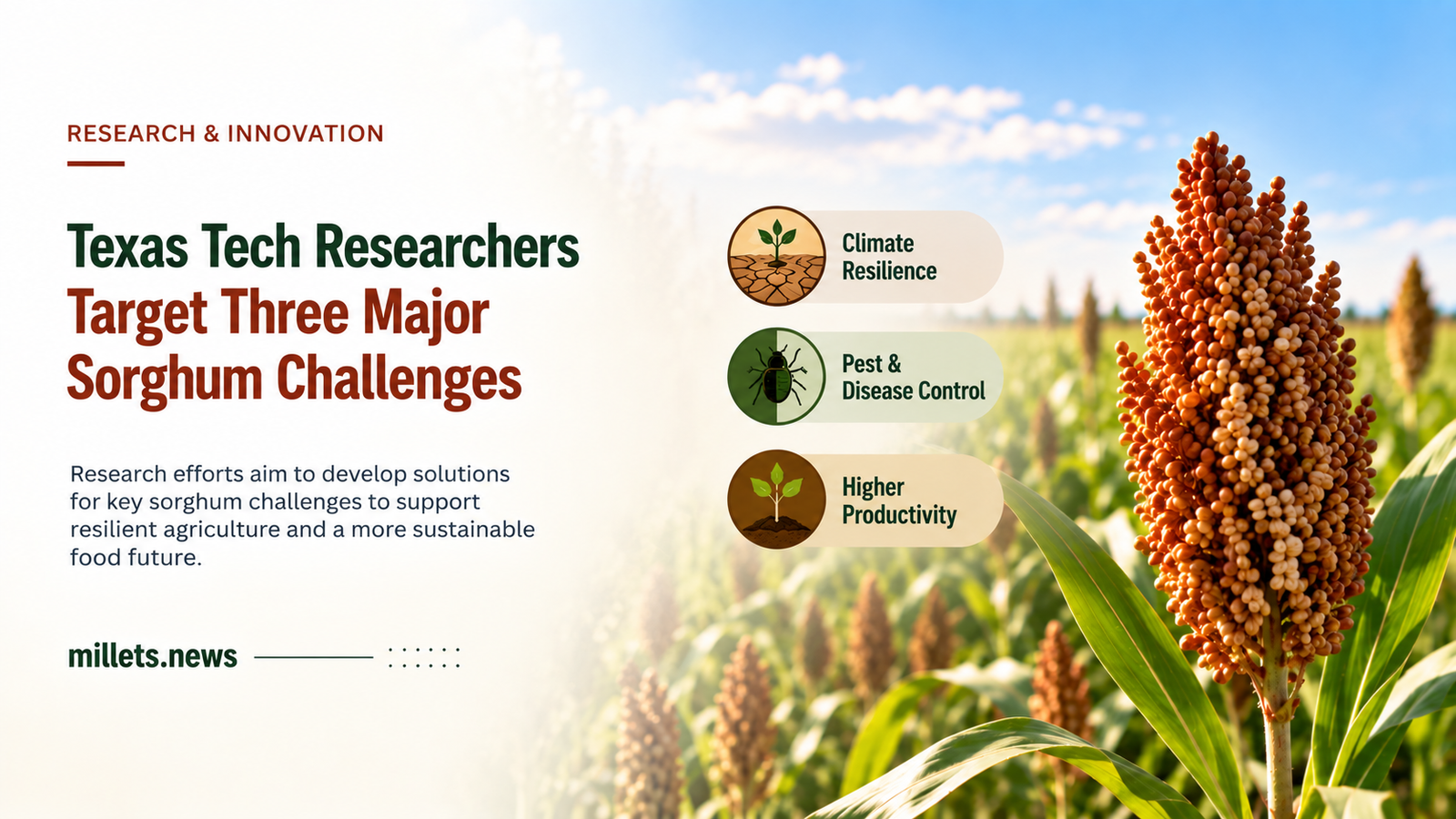
A new generation of scientists at Texas Tech University is tackling some of the practical challenges surrounding sorghum production and utilisation, with research spanning early-season cold tolerance, livestock nutrition and resistance to crop lodging.
The work involves three graduate students at the university's Davis College of Agricultural Sciences & Natural Resources: master's students Nicholas McNab and Ahmari D. Henry, and doctoral researcher Mayank Bangari. Their projects illustrate the diverse scientific questions being investigated as Texas Tech prepares to host the Global Sorghum Conference later this month.
McNab is investigating whether forage sorghum can be planted earlier in West Texas by improving understanding of its chilling tolerance. Sorghum is traditionally planted in the region during May and June, but his experiment compares planting dates of April 1, April 15 and May 1, with corn serving as a control crop.
Earlier establishment could potentially allow producers to make better use of soil moisture remaining after winter. Although the trial is still preliminary, McNab reports that forage sorghum currently appears to be performing better than corn in the experiment. The early observation should not yet be interpreted as a final research result.
A second project explores sorghum from the perspective of livestock nutrition.
Henry is studying how cattle digest sorghum when it is used as an alternative to conventional feed grains such as corn. Her research involves four prussic acid-free sorghum hybrids, with measurements including feed intake, particle size and pH.
The research could have particular relevance to livestock production in semi-arid areas. Sorghum's comparatively strong performance under limited-water conditions creates interest in its potential as a locally produced feed grain when other crops face moisture constraints.
Bangari's doctoral research addresses another major production challenge: lodging, when sorghum plants fall or bend toward the ground at their roots or stalks.
According to Bangari, lodging can contribute to grain sorghum yield losses ranging from 20% to 80%. His research seeks to identify structural characteristics associated with stronger stalks and, eventually, genetic markers that breeders could use to develop more lodging-resistant varieties.
One technology being used is the Device for Assessing the Resistance to Lodging In Grains (DARLING), an electromagnetic instrument developed by a University of Idaho mechanical engineer. The equipment enables researchers to simulate plant failure and assess stalk strength more systematically.
Bangari is also examining individual internodes across thousands of sorghum stalks. The longer-term objective is to identify genetic markers associated with stalk strength and provide those insights to breeders developing varieties capable of withstanding strong winds across the U.S. Sorghum Belt.
Together, the three projects demonstrate how sorghum research increasingly extends beyond conventional yield improvement. Scientists are investigating how the crop can be planted under challenging early-season conditions, utilised more effectively in livestock systems and genetically improved for greater structural resilience.
For the sorghum industry, such work could ultimately contribute to more resilient production systems. However, several of the projects remain underway, meaning their observations should be presented as ongoing research rather than established recommendations for farmers.