 By Admin
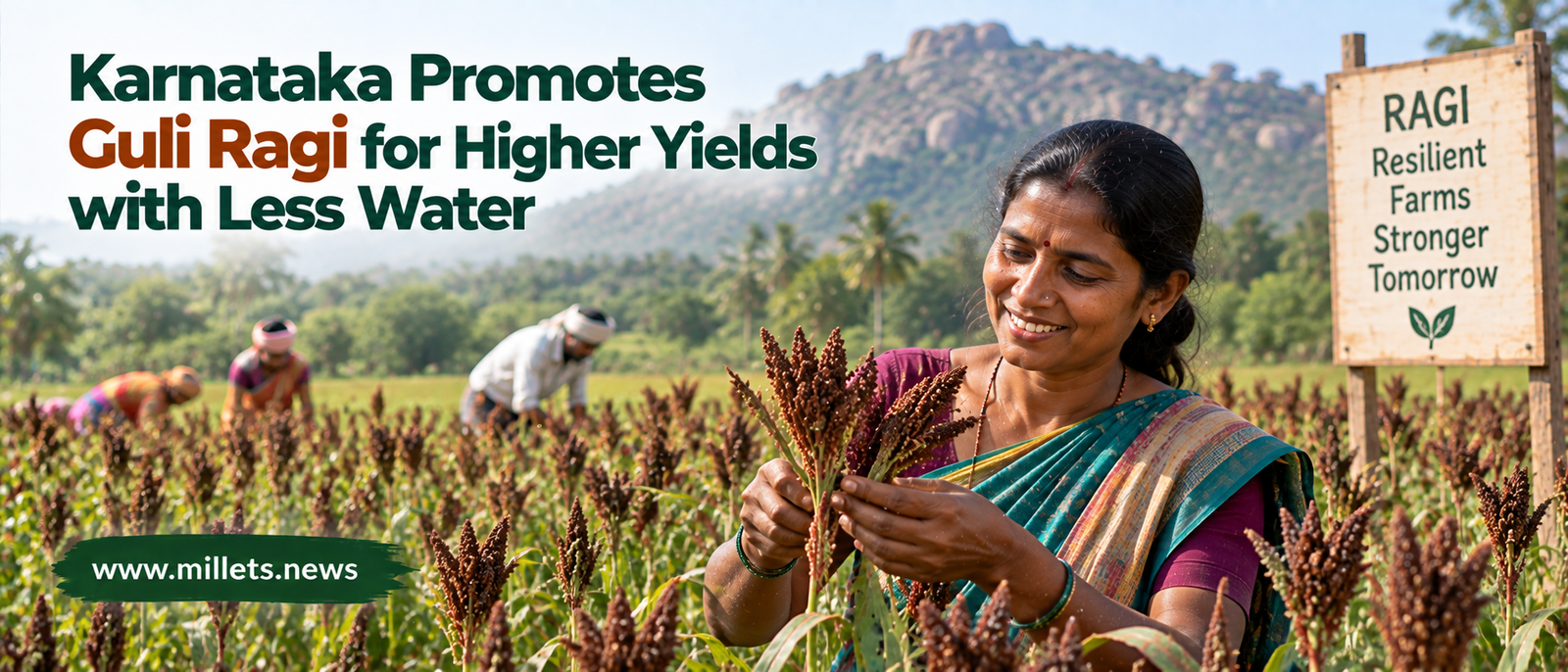
A traditional finger millet cultivation technique from Karnataka is receiving renewed attention as farmers contend with insufficient rainfall and increasing pressure on irrigation resources.
Kisan Mall, working with the Departments of Agriculture and Horticulture, organised a free online training programme on September 23 to introduce more farmers to the Guli Ragi method. Also known as the pit system, the technique is designed to improve crop establishment, resource efficiency and ragi productivity.
Under conventional cultivation conditions, many farmers reportedly harvest approximately 15 quintals of ragi per acre despite using improved varieties and fertilisers. Farmers practising Guli Ragi in parts of Haveri district have reportedly achieved yields of around 20 quintals per acre, demonstrating the method’s potential under appropriate local conditions.
Guli Ragi differs from conventional finger millet cultivation in several respects. Young seedlings are transplanted at wider, more uniform intervals and established in pits or clearly designated planting locations. The spacing gives individual plants more room to develop while potentially enabling more efficient use of available moisture and soil nutrients.
The method has particular relevance in the Cauvery command area, where inadequate rainfall and water scarcity are creating difficulties for farmers. Water-intensive crops such as paddy become increasingly risky when irrigation supplies are uncertain. Finger millet cultivated through a water-conscious system could offer farmers a practical alternative in suitable areas.
The training programme combined institutional knowledge with practical farming experience. Mysuru district Joint Director of Agriculture Ravi K.H. was scheduled to discuss Guli Ragi’s importance under current rainfall and water conditions.
Agriculture writer Mallikarjuna Hosapallya was invited to explain the method’s origin and history. Shamaraj Hosamani, a subject-matter specialist from ICAR–JSS Krishi Vigyan Kendra in Suttur, was to provide technical guidance covering cultivation and implementation.
Progressive farmer and seed conservationist Shrenikraj Shivarayappa Yelavatti from Haveri was also included to share his experience of adopting the method. Incorporating farmer knowledge is important because Guli Ragi originated as a local agricultural practice rather than as an entirely laboratory-developed production system.
The approach resembles other crop-intensification systems that emphasise young seedlings, wider spacing, soil aeration and careful resource management. However, outcomes can vary according to soil, rainfall, variety and farm management. Farmers should therefore adapt the method to local conditions with suitable technical guidance.
The programme highlights how traditional agricultural knowledge can contribute to contemporary challenges. Reviving farmer-developed cultivation systems could help improve ragi productivity while supporting water conservation, climate resilience and more sustainable dryland agriculture in Karnataka.