 By Admin
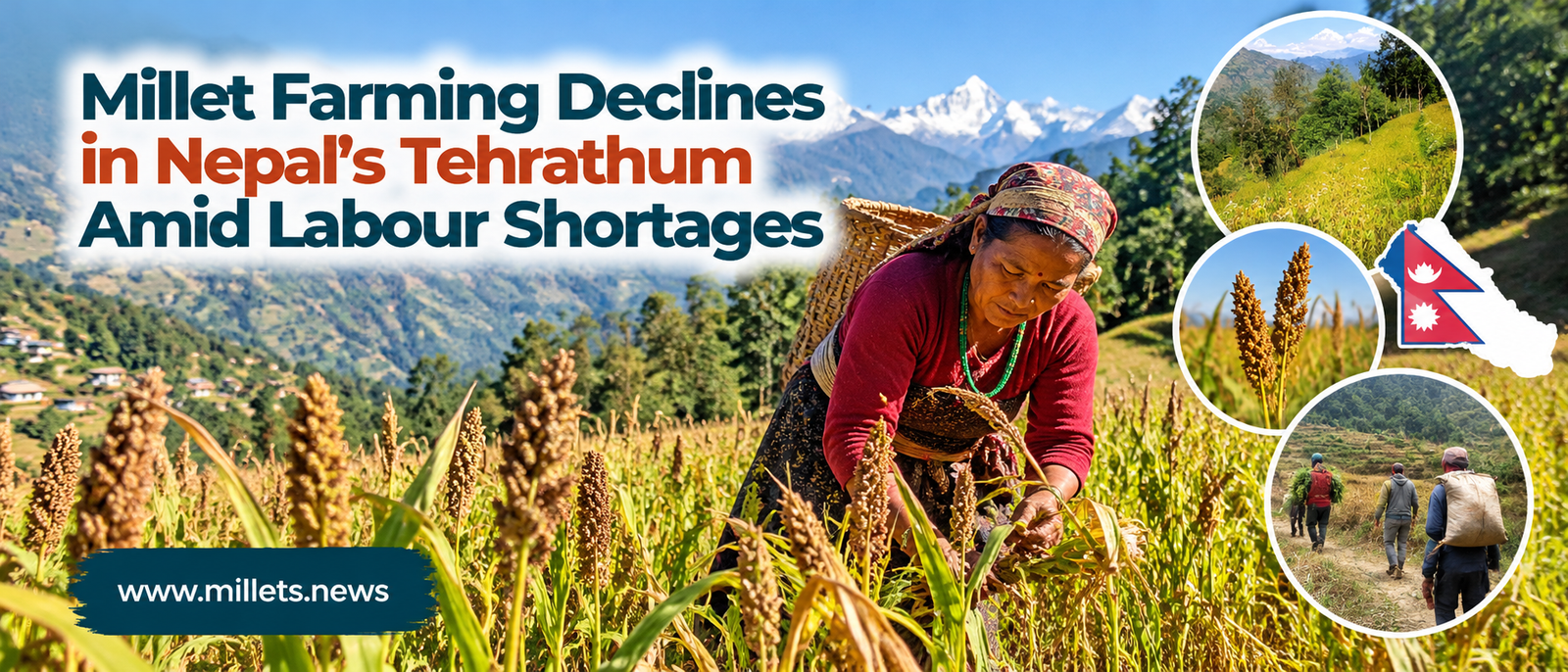
Traditional millet cultivation is gradually declining in Nepal's Tehrathum district as rural communities face agricultural labour shortages, migration of young workers and increasing competition from more profitable cash crops.
According to an October 28, 2026 report by OnlineKhabar, millet was once an important part of agricultural life in Tehrathum, where families cultivated the grain alongside maize and used it to prepare traditional foods.
Farmers previously relied on a community labour-sharing practice known as parma, under which villagers helped one another complete planting and other agricultural activities.
This system enabled households to manage labour-intensive farming even when they did not have enough workers within their own families.
However, the practice has weakened as younger residents leave rural communities for education and employment in cities and overseas.
Tank Bahadur Karki, a farmer from Chhathar Rural Municipality, explained that agricultural workers who were once readily available during planting seasons have become increasingly difficult to find.
Another local farmer, Agra Bahadur Karki, identified labour requirements and the greater income potential of alternative crops as reasons farmers are reducing millet cultivation.
Farmers are increasingly prioritising cardamom, ginger, broom grass and vegetables because these crops offer opportunities to earn cash income for household expenses.
The transition reflects broader changes in rural livelihoods, where families must meet growing financial needs while managing a shrinking agricultural workforce.
Millet has traditionally been used to prepare foods such as dhido, flatbreads and porridge. Although its cultivation is declining in some villages, the crop continues to offer opportunities for food processing and value addition.
Millet flour can be incorporated into products such as biscuits and cakes. It can also be blended with wheat flour to prepare momo wrappers, provided the formulation achieves suitable texture and taste.
A hospitality business in neighbouring Dhankuta district illustrates this potential.
According to Lokendra Karki, operator of Nunthala Village and Resort, visitors enjoy millet-based dhido and momo, while some purchase millet biscuits as gifts.
These examples suggest that restaurants, tourism businesses and food processors could help expand commercial demand for traditional millet products.
However, greater interest in millet-based foods does not automatically translate into increased cultivation. Farmers must also have access to labour, viable prices and reliable buyers.
The Tehrathum experience highlights a challenge for agricultural development: traditional grains may attract renewed consumer interest even as the communities that cultivate them face economic and demographic pressures.
For Nepal's millet sector, the report underscores the importance of connecting value-added food markets with practical support for local producers.
Strengthening market connections, reducing labour constraints and improving the economic attractiveness of millet cultivation could help traditional crops remain part of rural farming systems.
The article does not provide district-wide production statistics or a quantified rate of decline, so the findings should be understood as locally reported farming trends rather than a measured national decrease.