 By Admin
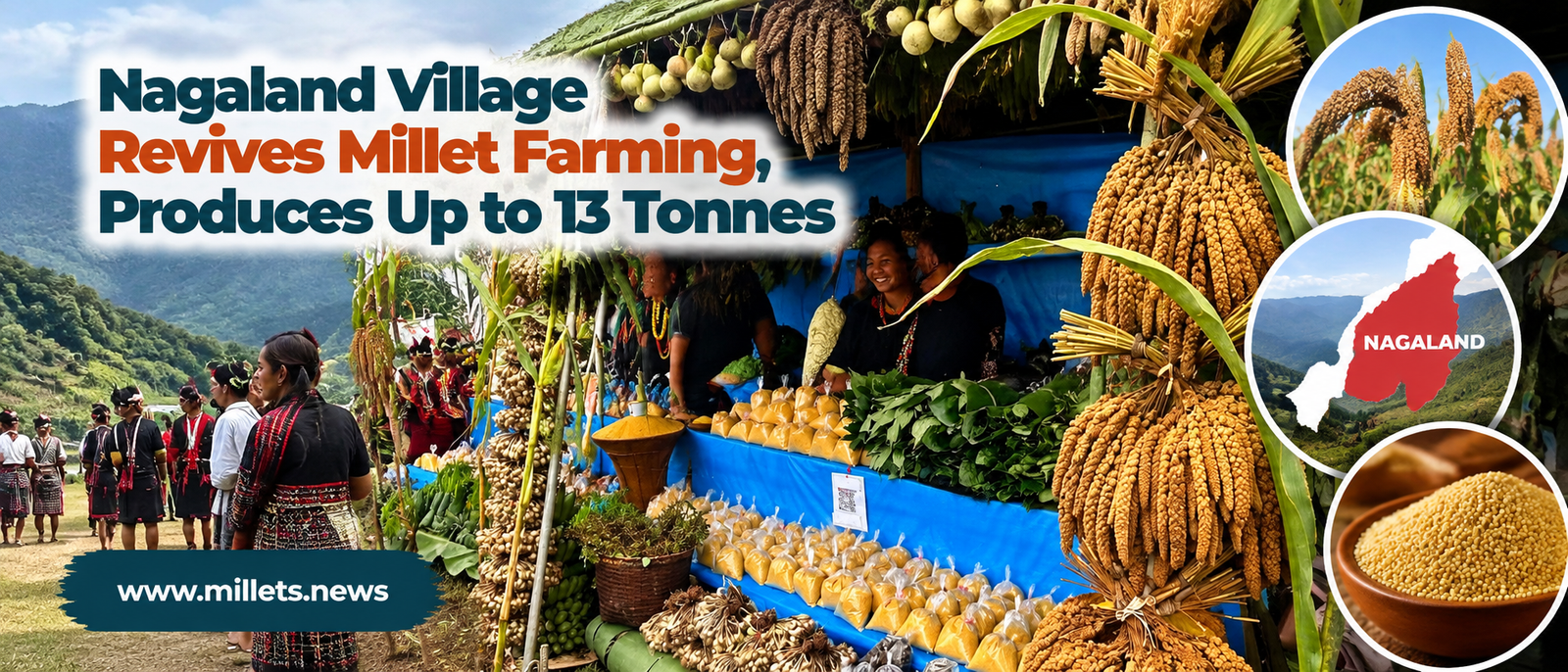
Kezoma village in Nagaland's Kohima district has emerged as an example of how traditional millet cultivation can be revived through community participation, government support and improved agricultural technology.
According to a report published by The Morung Express on October 27, 2026, millet farming had disappeared from the village for more than a decade. The prolonged decline meant that many younger residents had grown up without direct experience of cultivating a crop once familiar to earlier generations.
The revival began in 2024 when the District Agriculture Office, Kohima, partnered with the Kezoma Village Council to encourage farmers to return to millet cultivation.
Through awareness programmes, farmer mobilisation and technical assistance, the village brought one hectare under millet cultivation during the first year.
The initiative subsequently expanded as farmers recognised the crop's potential for household consumption and income generation.
By 2026, the village's millet production was reported at approximately 12,000–13,000 kilograms, with average yields of 2,000–2,500 kilograms per hectare.
The area under millet cultivation also doubled compared with 2025, reflecting increased participation among local farmers.
One of the most significant improvements came from the introduction of mechanised processing equipment.
The District Agriculture Office initially provided a millet mill that reportedly reduced labour requirements during post-harvest processing by about 80%.
This improvement encouraged more villagers to take up cultivation, as threshing and milling had previously required considerable manual effort.
Following the initial success, the department supplied an additional millet mill and a threshing machine to strengthen processing capacity.
Community marketing initiatives have also contributed to the revival.
In 2025, Kezoma organised its first Millet Festival, showcasing locally produced grain and value-added millet foods.
Approximately 4,000 kilograms of millet grain were displayed and marketed during the event. According to the official report, sales of millet grain and processed products generated around ₹13–14 lakh in a single day.
These figures represent reported event sales, not the annual income or profit of individual farmers.
The village has also begun exploring the possibility of growing millet twice within the same year.
After experimental second-season cultivation in 2025, farmers expanded the practice in 2026, bringing approximately two hectares under a second millet crop.
Harvesting of this additional crop was expected in November 2026.
To support cultivation during periods of limited water availability, a sprinkler irrigation system was introduced through the Per Drop More Crop scheme.
The irrigation support is intended to improve water-use efficiency and make additional cropping more practical.
Kezoma's experience illustrates the potential benefits of combining traditional crops with appropriate machinery, irrigation and market access.
For millet-growing communities elsewhere in India, the initiative provides an example of how reducing processing difficulties and strengthening local demand may encourage farmers to restore crops that have gradually disappeared from agricultural landscapes.
However, the reported production, labour savings and sales figures come from the Nagaland government's account of the initiative and should be understood as reported project outcomes rather than independently audited results.