 By Admin
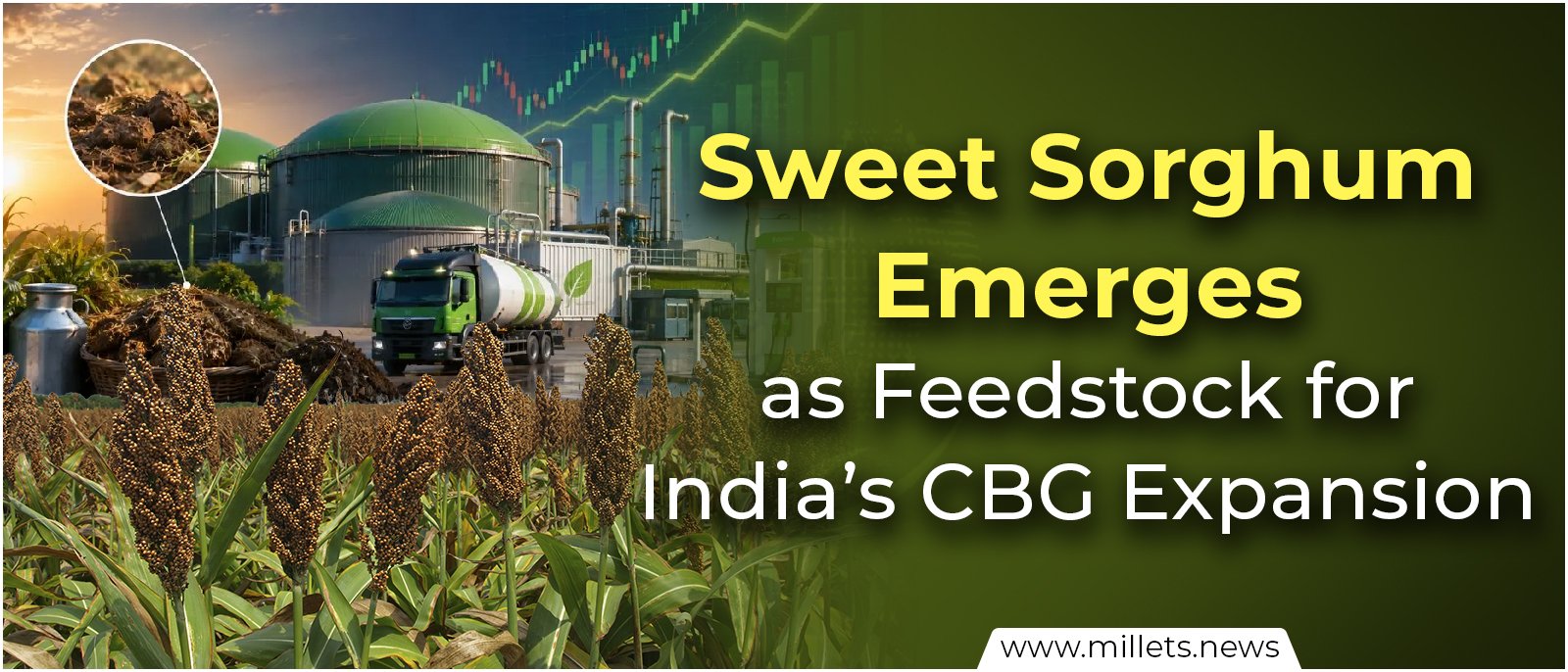
India’s ambitious expansion of compressed biogas could create a new opportunity for sweet sorghum, positioning the versatile crop at the intersection of agriculture and renewable energy. As the country works toward establishing 5,000 CBG plants by 2030, researchers are exploring agricultural feedstocks capable of supporting domestic bioenergy production while reducing reliance on imported fossil fuels.
The Government of India’s broader objective is to build a substantial domestic compressed biogas ecosystem. The 5,000-plant vision is associated with a production ambition of approximately 15 million metric tonnes of CBG annually by 2030, according to the Confederation of Indian Industry. Such expansion will require greater availability and diversification of biomass feedstocks.
Sweet sorghum could become one of those alternatives. Dr. A. V. Umakanth of ICAR-IIMR said the crop offers potential as a bioenergy feedstock because its sugar-rich juice can be converted into ethanol or compressed biogas. This creates an additional industrial pathway for a crop already valued for its adaptability to challenging agricultural environments.
Importantly, the crop’s bioenergy value does not end after juice extraction. The fibrous bagasse remaining from sweet sorghum can also serve as feedstock for CBG production, allowing multiple components of harvested biomass to be utilised. Such cascading use could improve resource efficiency and strengthen the economics of biomass-based energy systems.
India’s CBG expansion is part of a wider strategy to strengthen energy security while reducing pollution and carbon emissions. Recent industry reporting indicates that 132 plants supported by central financial assistance are operational and around 240 are under construction, although other official-sector datasets use different plant-count definitions.
Domestic technology development is another important component of the transition. Indian engineering companies are developing biomass pre-treatment technologies intended to improve digestion and methanation efficiency. Combining better processing technologies with new agricultural feedstocks could help address some of the technical and economic challenges associated with scaling renewable gas production.
For farmers, an expanding bioenergy market could potentially create additional demand channels for agricultural biomass. CII has highlighted CBG’s potential to generate rural livelihoods and additional farmer income while converting agricultural residues and other organic materials into renewable energy. However, commercially viable supply chains, feedstock logistics and reliable offtake will remain essential.
The development is particularly interesting for the global sorghum sector because it demonstrates how the crop’s role can extend well beyond food and livestock feed. Different sorghum types are increasingly being investigated for applications across biofuels, renewable gas and other bioproducts, broadening the economic possibilities surrounding this climate-adaptable cereal.
Sweet sorghum therefore represents a compelling example of a multipurpose crop within the emerging circular bioeconomy. If research, commercial production and CBG infrastructure can be successfully connected, its juice and residual biomass could contribute to renewable fuel production while creating new value streams within agricultural landscapes.