 By Admin
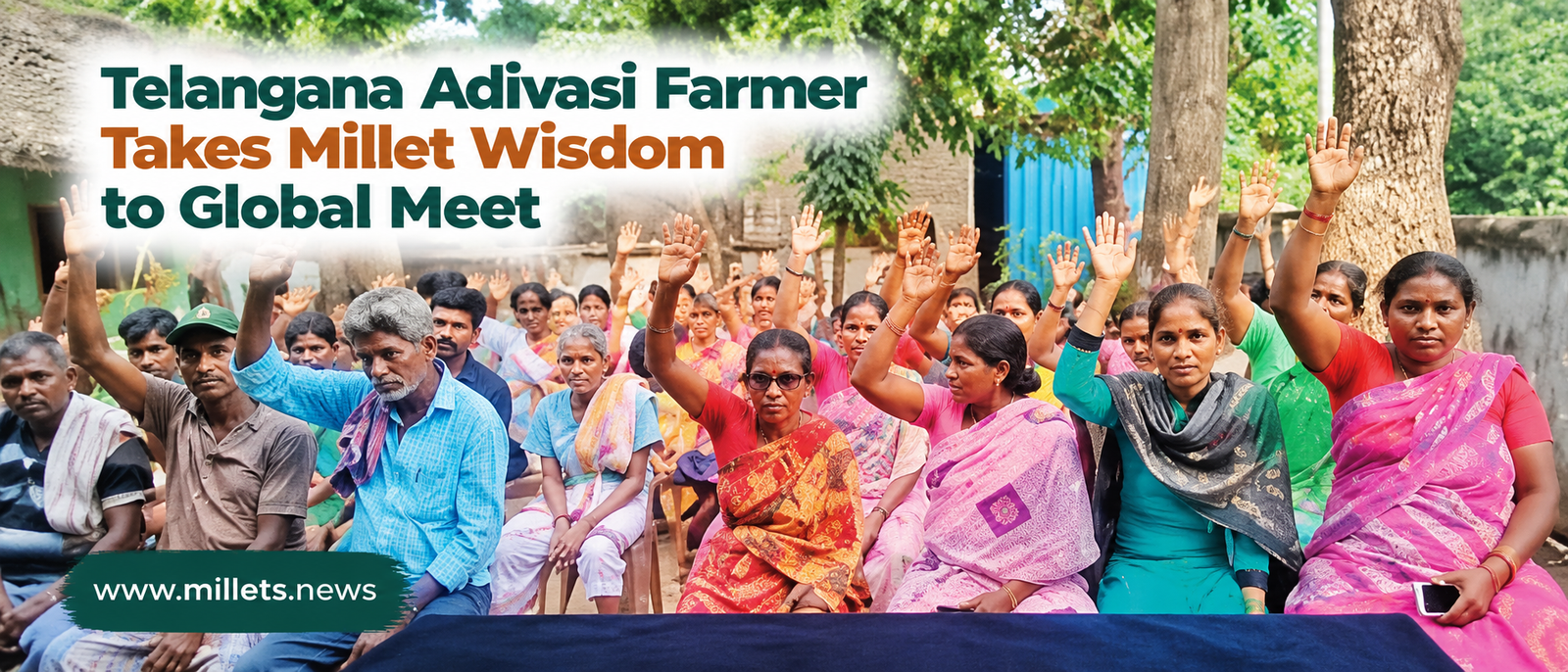
Traditional millet farming practices followed by Adivasi communities in Telangana have reached an international platform through Marsakola Kamala, a farmer from Navgad village in Tiryani mandal of Komaram Bheem Asifabad district.
Representing the Jai Jangubai Mahila Sangam, Kamala participated in an international meeting on Agroecology and Climate Justice held in Cambodia from September 21 to 26. Representatives from India, Cambodia and the Philippines exchanged experiences on traditional agriculture, local crops, seed rights and climate challenges.
Kamala highlighted the agricultural knowledge maintained by Adivasi communities in villages including Kheraguda, Pangidi Madara, Magurmodi Kannepalli and Mangi in Tiryani mandal.
Their traditional cropping systems include korralu (foxtail millet), samalu (little millet), jowar (sorghum) and several pulses. These crops have historically contributed to household food supplies and reduced dependence on external grain markets.
Kamala has been encouraging local communities to continue cultivating and consuming millets for their own food requirements. She noted that Adivasi households were traditionally more self-reliant because they cultivated food grains and preserved seeds from one harvest for use in the next season.
However, those practices have gradually weakened as farmers have moved toward commercial crops such as cotton and soybean, while changing climatic conditions are creating additional challenges for traditional agriculture.
At the Cambodia meeting, Kamala shared experiences related to maintaining traditional crops under changing climatic conditions and transferring agricultural knowledge to younger generations. Participants also discussed protecting farmers' and communities' rights over traditional seeds.
The Telangana experience illustrates how millet conservation can extend beyond preserving individual crops. Traditional seeds, local knowledge and community-based farming systems can together contribute to locally adapted food systems, particularly in regions facing increasing climate uncertainty.