 By Admin
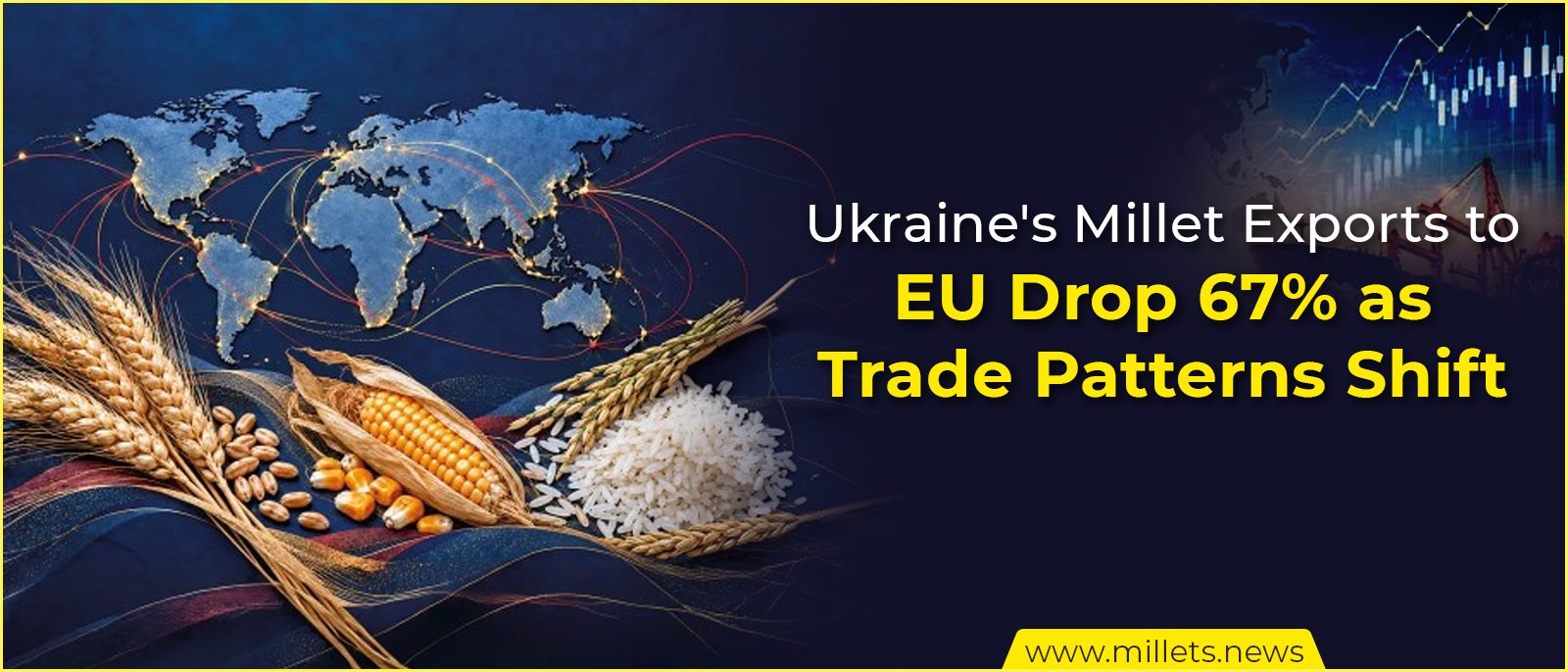
Ukraine has experienced a substantial decline in millet exports to the European Union during the opening months of the 2026–27 marketing year, reflecting changes in international trade flows and European import demand.
According to trade figures reported by UkrAgroConsult, citing Mundus Agri and data from the European Commission's DG AGRI and TAXUD customs surveillance system, Ukraine exported approximately 2,800 tonnes of millet to the EU between July 1 and October 25, 2026.
This compares with 8,480 tonnes during the corresponding period of the previous marketing year, representing a decline of approximately 67%.
As a result, Ukraine's share of EU millet imports from countries outside the bloc decreased from 81.3% to 44.8%.
Despite the sharp reduction, Ukraine remained the EU's largest external millet supplier during the reporting period.
The decline occurred alongside a broader contraction in European millet imports.
Total EU imports from non-member countries fell from 10,430 tonnes to 6,240 tonnes, a year-on-year decrease of 40.2%.
The total value of these imports declined from €4.09 million to €2.97 million.
However, the average import price increased by approximately 23%, reaching around €480 per tonne.
This combination of lower import volumes and higher average prices indicates changing market conditions, although the data alone does not establish the causes of the price increase.
Other exporting countries expanded their participation in the European market.
Russia emerged as the second-largest external supplier during the period, shipping approximately 1,370 tonnes, compared with no recorded shipments during the corresponding period a year earlier.
Argentina increased millet exports to the EU by 70.8%, reaching 777 tonnes.
Ethiopia also expanded its shipments, more than doubling exports to 136 tonnes.
Meanwhile, China's millet exports to the EU declined by 27.4% to 438 tonnes.
India recorded a particularly sharp decrease, with shipments falling by 79.1% to 122 tonnes.
These changes illustrate how the distribution of suppliers has shifted as overall European demand weakened.
Among EU member states, Poland and Germany remained major import destinations.
Poland imported approximately 1,770 tonnes of millet, representing a decline of 10%.
Germany's imports fell by 39% to 1,520 tonnes.
In contrast, Belgium increased its purchases by 15% to 717 tonnes, while Hungary recorded a 29% increase to 713 tonnes.
The report also highlighted subdued trading activity in China, where some farmers were reportedly holding back harvested millet because of dissatisfaction with prevailing prices.
In late October, conventional hulled millet was quoted at approximately $1,030 per tonne FOB Dalian, compared with $1,100 per tonne for organic millet.
These Chinese export quotations represent a different product and trading basis from the EU's average import price and should not be compared directly.
For the global millet sector, the figures demonstrate how international trade patterns can change within a relatively short period.
Ukraine's reduced market share may create opportunities for competing suppliers, but future developments will depend on production availability, prices, logistics and demand.
The report does not establish whether the reduction in Ukrainian exports resulted primarily from lower production, commercial decisions, transport constraints or other factors.
Nevertheless, the scale of the decline highlights the importance of monitoring millet trade flows across Europe.
As the 2026–27 marketing year progresses, subsequent customs data will help determine whether Ukraine's reduced share represents a temporary shift or a more sustained change in the European millet market.