 By Admin
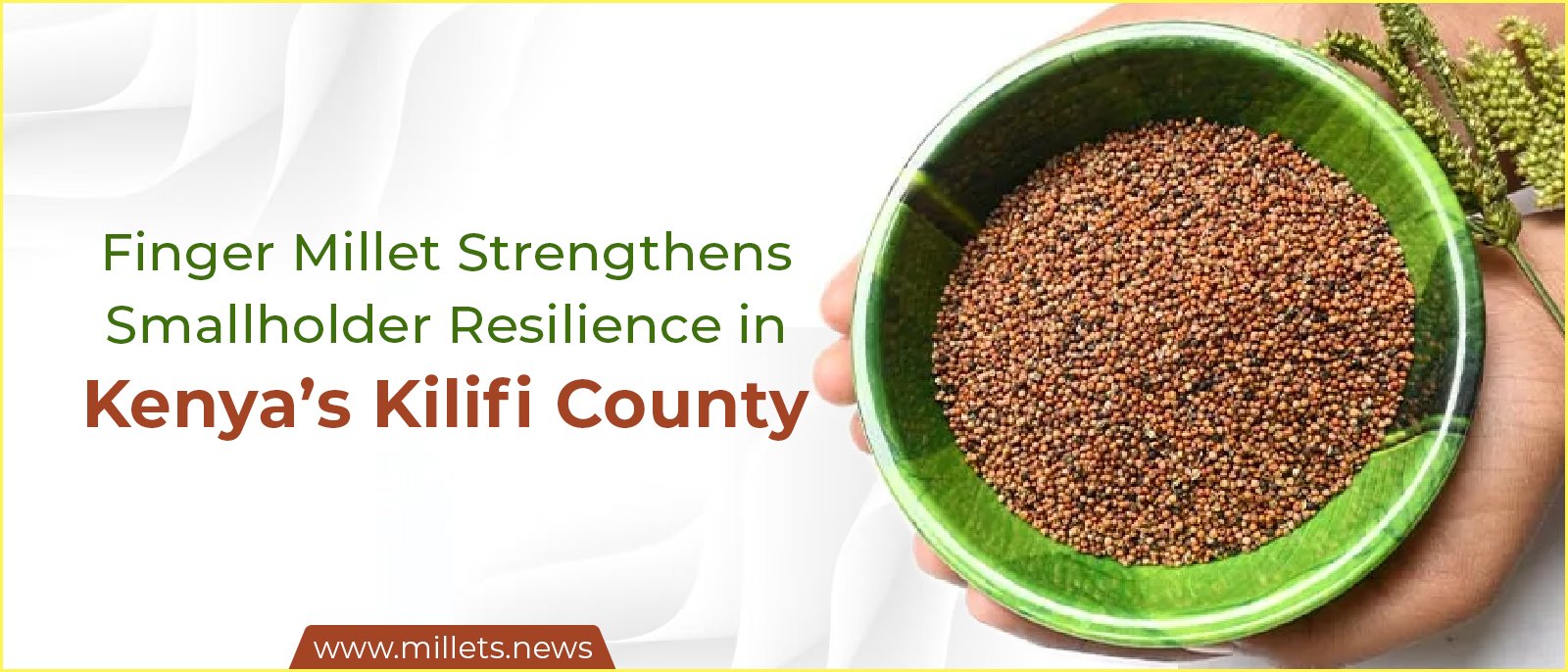
Finger millet is emerging as one component of a broader effort to strengthen food security, climate resilience and rural livelihoods among smallholder farming communities in East Africa.
The Empowering Farmers Foundation (EFF) works with agricultural communities across Kenya, Tanzania, Zambia and Mozambique. Its programmes combine farmer training with access to agricultural inputs, climate-smart practices, finance, technology, processing opportunities and markets.
For the millet sector, one of the most relevant initiatives is located in Kilifi County, Kenya, where EFF's Matsangoni work has incorporated finger millet alongside activities involving cashew production and farmer organisation. Farmers have been encouraged to diversify production while strengthening household nutrition and income opportunities.
EFF's own documentation provides additional detail on this millet component. Groups of women farmers have integrated finger millet—locally known as wimbi—into their farms, sometimes intercropping it with cashew and moringa trees as part of diversified agroforestry systems.
The approach is particularly relevant in areas where rainfall uncertainty and difficult growing conditions increase the risks associated with dependence on a narrow range of staple crops. EFF positions indigenous food crops and diversification among the strategies that can contribute to climate resilience.
The programme also connects millet cultivation with household consumption. EFF has organised nutrition-awareness activities and cooking demonstrations to encourage communities to incorporate finger millet into familiar foods. Participating households have used the grain for home consumption while farmers can sell surplus production in local markets.
This combination of production, nutrition and income generation illustrates an important opportunity for millet development. Expanding cultivation alone may have limited impact if farmers lack markets, processing opportunities or consumer demand.
EFF's wider model consequently treats farmers as participants in agricultural value chains rather than simply recipients of inputs. The organisation works on market linkages, financial services, farmer organisations, storage, distribution and entrepreneurship skills alongside agricultural production.
There is also a potential seed-enterprise dimension. EFF has previously stated an ambition to help participating women farmers become finger millet seed merchants, which could improve local access to planting material while providing an additional income opportunity.
Across its African programmes, EFF works with many commodities besides millet. Therefore, the organisation's overall impact should not be portrayed as a millet-specific programme. Nevertheless, the Kilifi experience provides a useful example of how finger millet can be incorporated into a broader development model connecting crop diversification, household nutrition, climate adaptation and smallholder livelihoods.