 By Admin
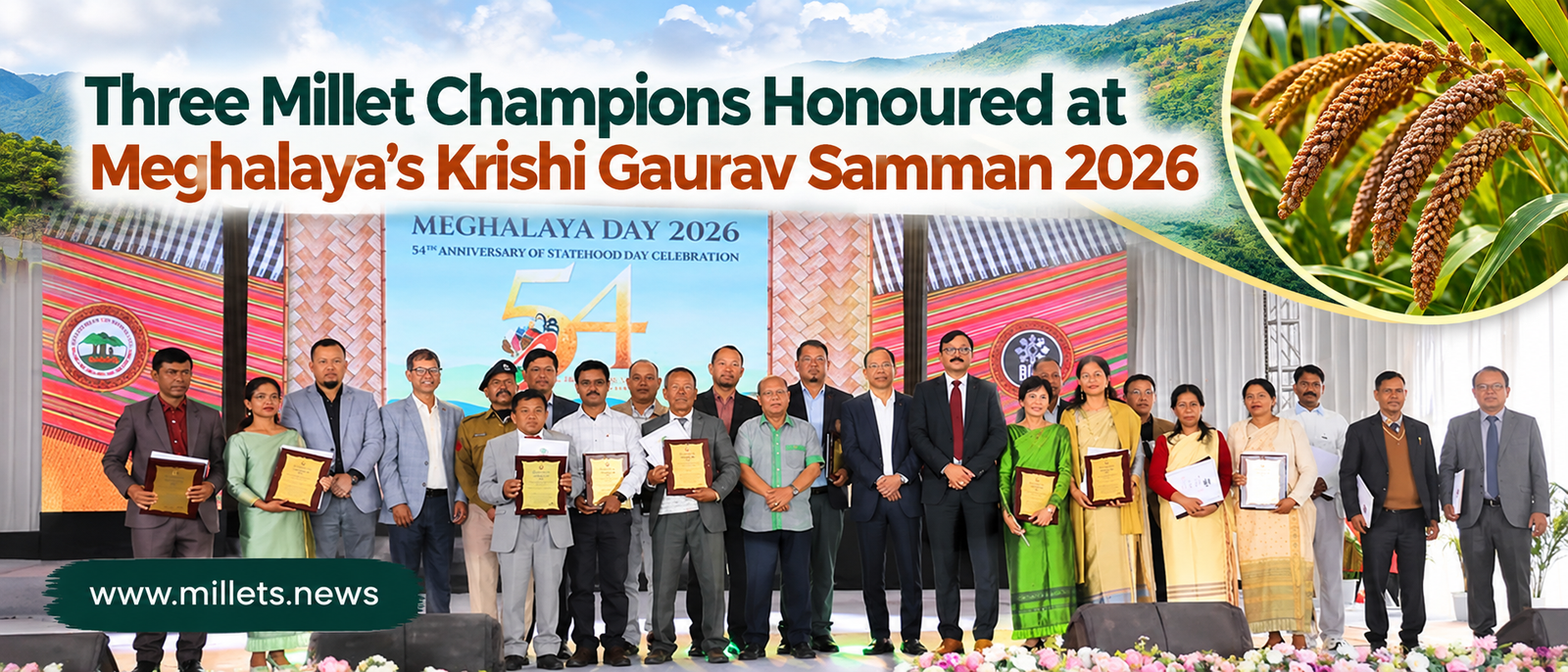
Three farmers and agricultural entrepreneurs associated with millet cultivation and conservation in Meghalaya have received recognition at the Krishi Gaurav Samman 2026, highlighting the role of local communities in protecting traditional crops and developing rural agricultural enterprises.
The awards were presented on October 31, 2026, during the Academic Assembly held at the College of Post Graduate Studies in Agricultural Sciences, Central Agricultural University, in Umiam, Ri-Bhoi district.
According to a November 1 report by PTI, published by ThePrint, six farmers and agripreneurs were honoured for contributions to sustainable farming, indigenous crop conservation and rural entrepreneurship.
Among the recipients, three were recognised for their work specifically related to millets.
Chekjing Sangma, from Sadolpara village in West Garo Hills, received recognition for promoting modern millet farming methods and encouraging greater participation in millet cultivation.
Darapbiang Mulieh, from Khanduli village in West Jaintia Hills, was honoured for promoting millet value addition, an important activity in developing markets for traditional grains.
Sitrian Surong, also from Khanduli, received recognition for efforts to preserve Meghalaya's traditional millet heritage.
Their contributions reflect different aspects of agricultural development, from encouraging cultivation to improving opportunities for processing and maintaining indigenous farming traditions.
The remaining three awardees were recognised for contributions to other agricultural sectors.
Trinity Saioo, popularly known as Meghalaya's Lakadong Lady, was honoured for promoting indigenous Lakadong turmeric cultivation.
Jemnud Marpan of Thadnongniaw village in Ri-Bhoi district received recognition for conserving indigenous crops and agricultural biodiversity.
Midat M. Binau, a Professor of Practice at Manipur University, was recognised for agricultural entrepreneurship involving traditional spice crops and market development.
The recognition comes amid growing attention to Meghalaya's millet revival initiatives.
Some of the awardees had previously received national attention through Prime Minister Narendra Modi's Mann Ki Baat programme, which highlighted efforts to restore traditional millet cultivation.
The Academic Assembly was jointly organised by Purvottar Janajati Shiksha Samiti and Central Agricultural University's College of Post Graduate Studies in Agricultural Sciences.
The event focused on integrating indigenous knowledge, cultural practices and experiential learning into modern education.
Addressing participants, Central Agricultural University Vice-Chancellor Dr Anupam Mishra emphasised the importance of combining traditional agricultural knowledge with scientific research and innovation.
He also highlighted the role of tribal communities in conserving biodiversity and natural resources.
The event brought together 375 registered participants from educational institutions and other organisations across the region.
For Meghalaya's millet sector, the awards demonstrate growing institutional recognition of farmers who are working to sustain traditional crops.
The contributions of Sangma, Mulieh and Surong also show that millet development involves more than increasing cultivation.
Processing, value addition, community participation and the preservation of agricultural knowledge can all contribute to stronger local food systems.
By recognising these efforts, the Krishi Gaurav Samman 2026 draws attention to the farmers and entrepreneurs helping traditional millet crops retain their place in Meghalaya's agricultural landscape.