 By Admin
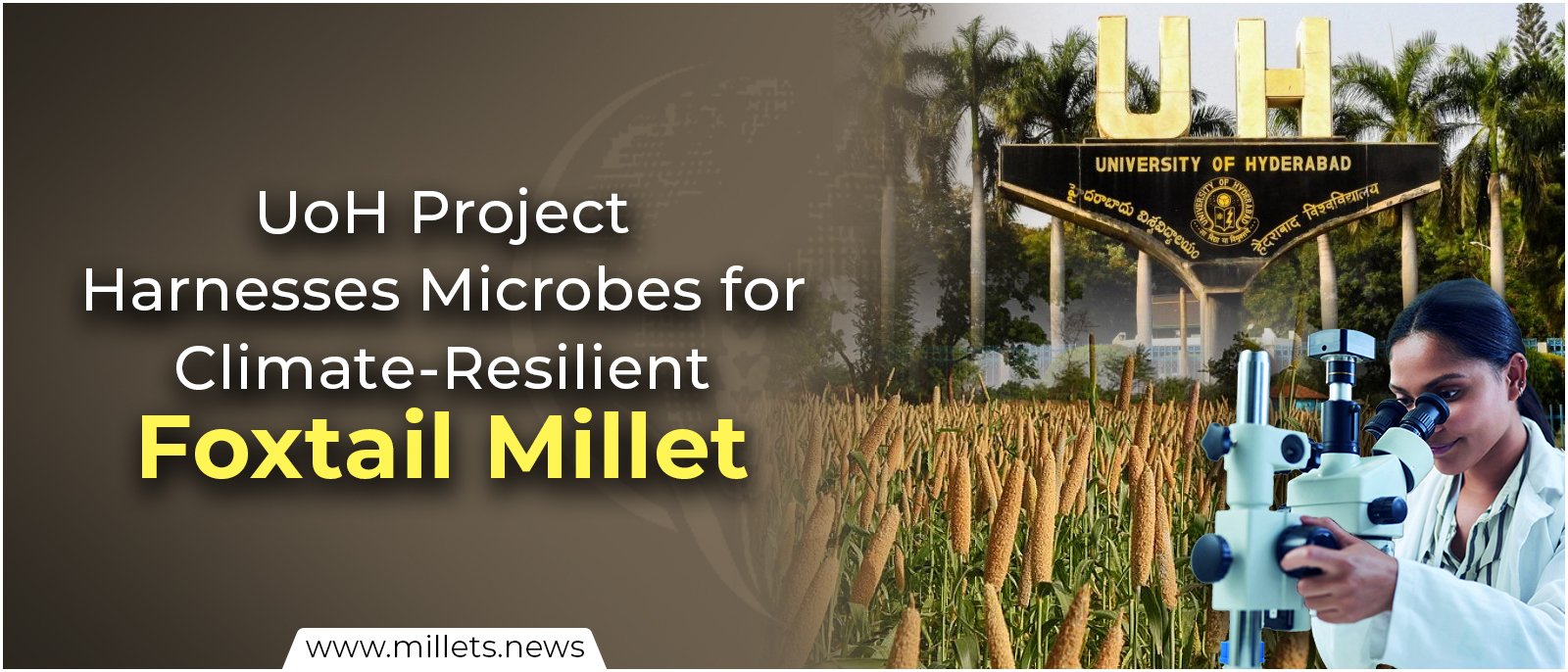
The University of Hyderabad is advancing a biotechnology-led approach to climate-resilient millet production through a new research project focused on foxtail millet. Scientists will investigate beneficial microorganisms associated with plants and develop microbial consortia designed to help the crop withstand climatic stresses while supporting more sustainable agricultural production.
The initiative forms part of two competitive research grants secured under the Department of Biotechnology’s BioE3—Biotechnology for Economy, Environment and Employment—Policy. Awarded through the DBT-BIRAC Joint Call for Proposals on Climate Resilient Agriculture, the two projects have a combined sanctioned value of ₹2.5 crore, with approximately ₹1 crore allocated to UoH.
Dr. M. Muthamilarasan of UoH’s Department of Plant Sciences is leading the university’s participation in both projects. For the foxtail millet initiative, he serves as Principal Investigator alongside Co-Principal Investigator Dr. Jogi Madhuprakash, with scientists from the University of Delhi South Campus, Tamil Nadu Agricultural University, GITAM and KIIT University also participating.
The research will explore plant-associated beneficial microbes and use this knowledge to develop sustainable biological inputs. These microbial solutions will subsequently be evaluated for their ability to strengthen climate resilience and support low-input agricultural systems before undergoing validation across multiple locations and different agro-ecological environments.
The approach could be particularly valuable for millet agriculture because it addresses resilience from both the crop and soil perspectives. According to UoH, the resulting bio-inputs are expected to strengthen crop performance under climate stress, improve soil health and yields, and reduce farmers’ dependence on chemical inputs.
Multi-location validation will be an important component of the programme. Agricultural technologies that perform successfully under controlled research conditions must also demonstrate effectiveness across different soils, climates and production environments. Testing the microbial formulations across diverse agro-ecologies should therefore provide important evidence about their potential for wider agricultural application.
The project also connects millet research with India's emerging bio-manufacturing economy. Successful development of indigenous microbial bio-inputs could create technologies that simultaneously support climate-resilient farming and expand domestic capacity for producing biologically derived agricultural solutions.
The second BioE3 project addresses a different crop challenge, combining gene editing and peptide-based foliar treatments to develop viral resistance in tomato. Together, the two projects illustrate how biotechnology can address crop resilience through different pathways, ranging from manipulation of plant-associated microorganisms to advanced molecular technologies.
For the international millet research community, the foxtail millet project demonstrates the expanding scientific toolkit being applied to climate adaptation. Breeding and genomics remain essential, but understanding the relationship between millet plants, beneficial microorganisms and soil ecosystems could provide complementary strategies for improving crop performance under increasingly difficult environmental conditions.
If successful, the research could contribute to a new generation of biologically supported millet production systems that combine crop resilience with healthier soils and reduced chemical dependence. Such approaches could strengthen foxtail millet's role not only as a climate-resilient grain, but also as part of more resource-efficient and sustainable dryland agriculture.